 Lexpad
How many new words a dayHow many new words
a day should you learn?
Most learners do well with 5 to 15 new words a day; Lexpad’s default is 15. The limit is not the new words but the reviews they bring: on Lexpad’s box schedule, every new word a day adds about five cards a day after a month and about eight after a year, even if you never miss one.
By Reza Pirighadim, who makes Lexpad. Checked against the app on 12 October 2026.
- A good pace
- 5 to 15 new words a day
- Lexpad default
- 15 a day
- Load, no misses
- 5× after a month, 8× after a year
- Rule of thumb
- 5 to 10 cards per new word a day
The short answer
Pick the number of new words you can keep reviewing, not the number you can meet in one sitting. Learning 50 words today is easy; seeing those 50 again tomorrow, in three days, in a week and in three weeks, while 50 more arrive every day, is not.
- 5 a day if you have about ten minutes and want it to feel light.
- 10 to 15 a day for a steady routine. Fifteen is Lexpad’s default.
- 20 or more only for a short push with time every day, such as the weeks before an exam or a move abroad.
Why spacing at all? Reviews spread out over days beat the same reviews crammed together; a review of 317 experiments found this again and again (Cepeda et al., 2006, Psychological Bulletin). The question is only how many words your days can carry.
The schedule behind the numbers
In Lexpad a new word starts in box 1 and is asked the day you add it. Each right answer moves it up one box, and each box waits longer: 1 day, 3 days, 7 days, then 21 days. Box 5 counts as mastered, and a mastered word you still know waits 45, 90, 180 and then 365 days. A miss sends any word back to box 1, asked again the same day.
So a word you know every time is seen on these days:
- Box 1Today
- Box 21 day
- Box 33 days
- Box 47 days
- Box 5 · mastered21 days, then longer
| Box | Seen on | Gap |
|---|---|---|
| Today | Day 0 | New, box 1 |
| Box 2 | Day 1 | 1 day later |
| Box 3 | Day 4 | 3 days later |
| Box 4 | Day 11 | 7 days later |
| Box 5 | Day 32 | 21 days later |
| Mastered | Day 77 | 45 days later |
| Mastered | Day 167 | 90 days later |
| Mastered | Day 347 | 180 days later |
| Mastered | Day 712 | 365 days later, then yearly |
The review load, worked out
Add the same number of new words every day and count the cards on one day. After a week, you see today’s new words plus the words from 1 and 4 days ago: 3 cards for every new word a day. From day 11 the words from 11 days ago join: 4. From day 32 the first box-5 words come back: 5. Then the mastered gaps add one more each: 6 from day 77, 7 from day 167 and 8 from day 347.
For 15 new words a day, that is 15 × 5 = 75 cards a day after a month, and 15 × 8 = 120 a day after a year. These include the 15 new ones. It grows slowly after the first month, because mastered words wait months between visits.
Work out your own numbers. The free spaced repetition calculator runs Lexpad’s own schedule day by day in your browser: your new words a day, a goal, misses, Boxes or Smart, and the cards and minutes they bring.
| New words | From day 4 | From day 32 | From day 167 | From day 347 |
|---|---|---|---|---|
| 5 a day | 15 | 25 | 35 | 40 |
| 10 a day | 30 | 50 | 70 | 80 |
| 15 a day | 45 | 75 | 105 | 120 |
| 20 a day | 60 | 100 | 140 | 160 |
| 30 a day | 90 | 150 | 210 | 240 |
What misses add
Nobody answers every card right, and each miss starts that word again from box 1: one more try that day, then 1, 3, 7 and 21 days. To see the size of it we ran a simple model on Lexpad’s own scheduling code (the one the calculator uses): 15 new words a day, each answer after the first missed at random at a fixed rate, a missed word retried once the same day.
- Missing 1 answer in 10: about 100 cards a day after two months, about 180 after a year.
- Missing 1 answer in 5: about 140 cards a day after two months, about 270 after a year.
This is a model, not a measurement of Lexpad learners: real misses cluster on a few hard words and fall as words become familiar. It shows the rule of thumb, though: plan on 5 to 10 cards a day for every new word a day. The Anki manual gives the same order of size: learning 20 new cards a day, it says, means roughly 200 reviews a day (Anki manual, deck options).
Setting it in Lexpad
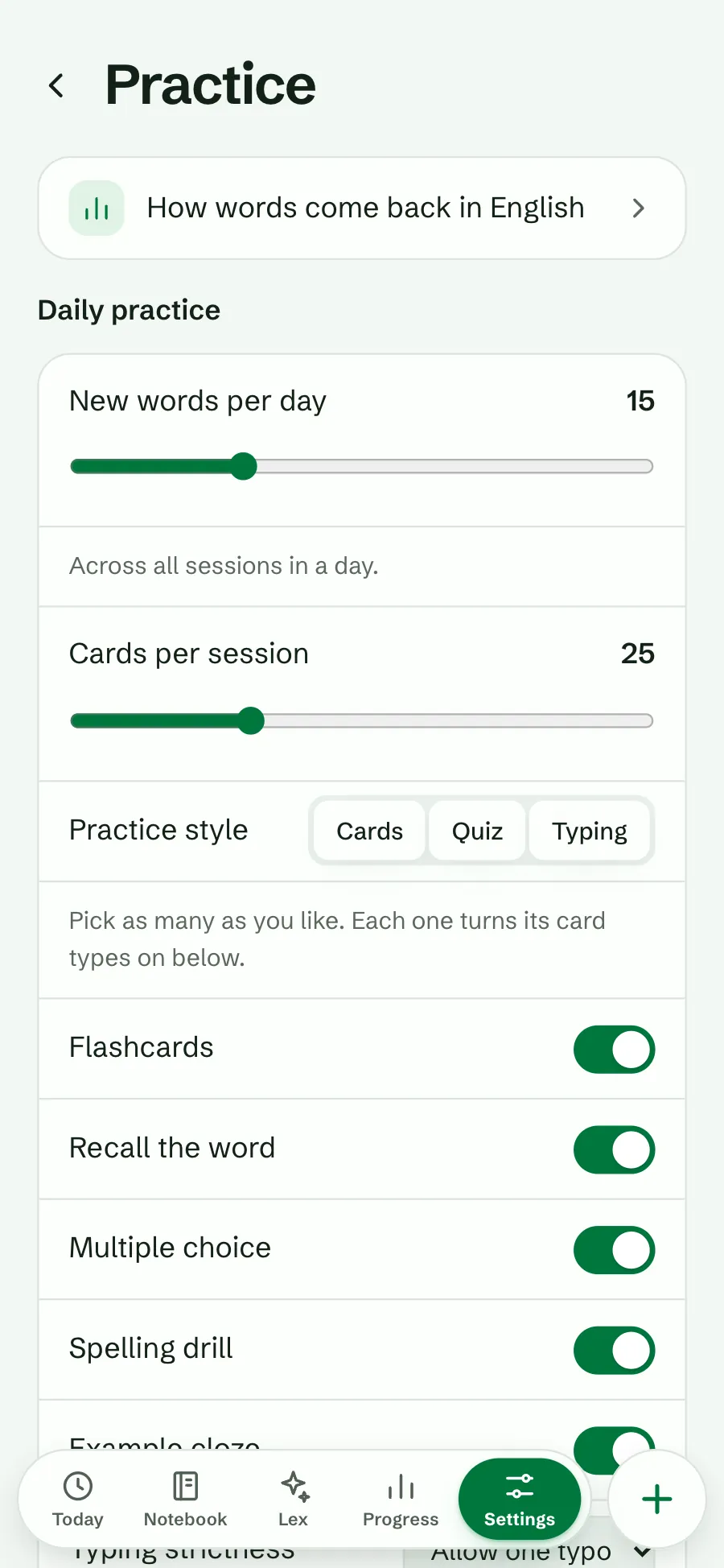
New words per day is in Settings, Practice, and it is 15 unless you change it. It counts across all your sessions in a day, so a second session does not bring another full set. Words you add beyond it are not lost: they wait as Not started and join on the next days, in the order you choose in Settings, Practice.
- Most reviews a day (per notebook, on its How words come back page): no limit by default, or 50, 100 or 200. Over the limit, the words most at risk come first, the rest wait, and new words pause, so a busy week never snowballs. Daily limits.
- Back after a break with more than 100 reviews waiting, Today offers a daily limit once, so the pile becomes a few calm days.
- Today shows how many words are due and about how long they take, before you start.
These are your own numbers, not plan limits: they are the same on the free plan.
Check your own numbers
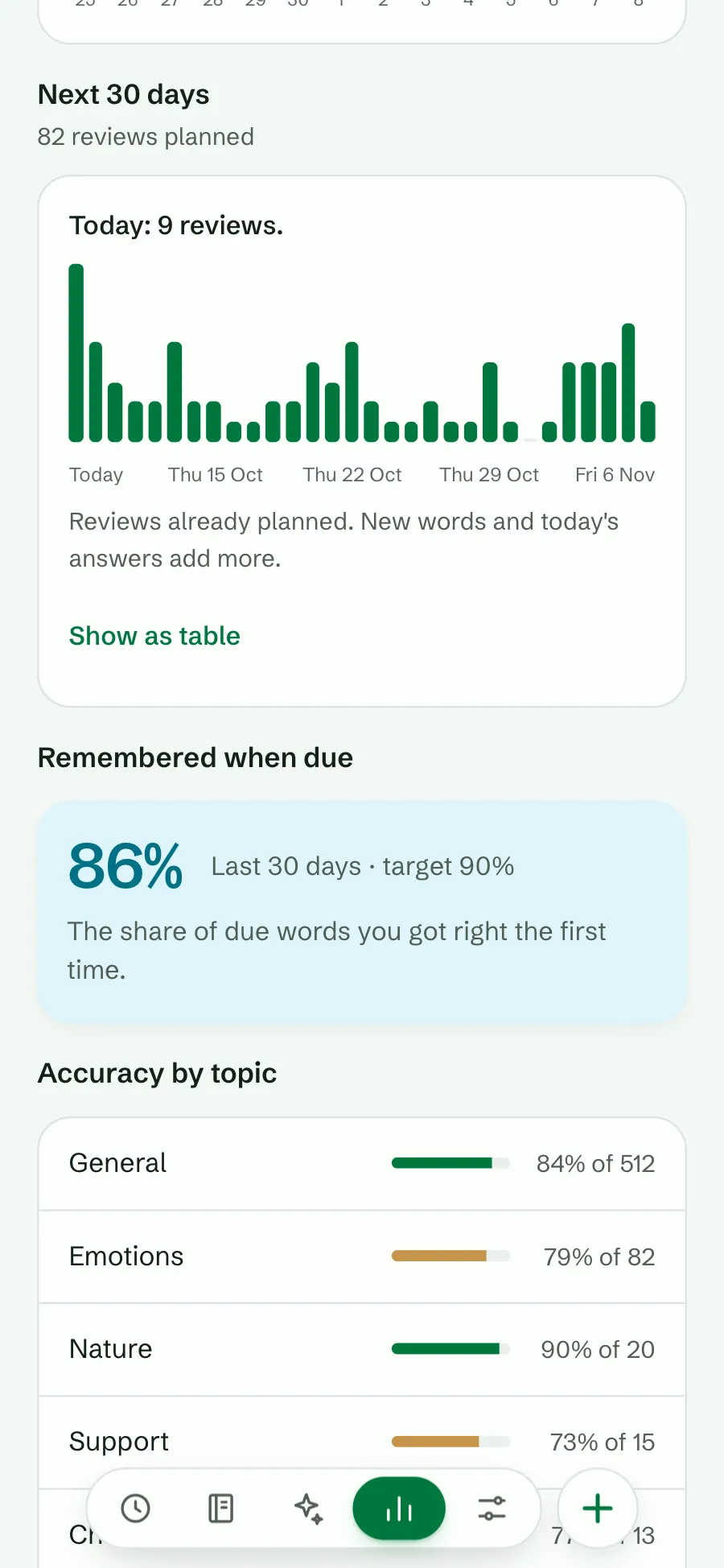
You do not have to trust our arithmetic. In Lexpad, Progress shows Next 30 days: a bar for each day with the reviews already planned. If the bars keep rising past the minutes you have, lower the new words per day for a week. If they are low, raise it. Forecast and retention.
With the Smart schedule
A notebook can use Smart (Beta) instead of boxes. Built on FSRS-6, it works out a gap for each word from your own answers, aiming at the share of words you want to remember: Relaxed 85%, Balanced 90% or Exam 95%. The fixed table above does not apply, but the trade-off does: a higher target means shorter gaps and more reviews a day, as the Anki manual also notes for FSRS. Start with Balanced and watch the forecast.
Keeping the pace
- Add words you actually met, with their sentence. A word with a story behind it costs fewer misses later.
- Be honest when you answer. A word marked right too early comes back weeks later, when it is harder.
- Lower the new words before you skip reviews. Skipped reviews pile up; fewer new words only slow the growth.
- A missed day is fine. Due words wait for you, and the most at-risk come first.
Good to know
Questions
Is 10 new words a day enough?
Yes. Ten a day is about 3,650 words a year if you keep reviewing, and on Lexpad’s schedule it means about 50 cards a day after a month and 80 after a year without misses.
Is 50 new words a day too many?
For most people, yes, over more than a few days. After a month it means at least 250 cards a day, and more with every miss.
Should I still add every new word I meet?
Add the ones worth keeping. New words per day only controls how many start practice each day; the rest wait in your notebook.
Do reviews keep growing forever?
Slowly. With the box schedule the daily load is about five times your new words after a month and eight times after a year, then grows by one more each year as mastered words return yearly.
Does the free plan limit how many words I can learn?
No. New words per day and Most reviews a day are your own settings, the same on every plan.
Lexpad
Your next word is worth keeping.
Lexpad is free to start, on the web and on Android. Bring the words you meet.