 Lexpad
Leitner box method
The Leitner system:
five boxes, one simple rule
The Leitner system, also called the Leitner method or Leitner box method, is a way to review flashcards so that easy words come back rarely and hard words come back often. Cards live in numbered boxes; a right answer moves a card up a box and a wrong answer sends it back to the first. Each box waits longer before its cards return.
By Reza Pirighadim, who makes Lexpad. Checked against the app on 13 October 2026. How this guide is made.
- Boxes
- Five
- Waits
- Today, 1, 3, 7, 21 days
- Wrong answer
- Back to step 1
- Mastered
- Step 5, back after 21 days up to a year
- Printable
- Free PDF, A4 or US Letter
The rule
Sebastian Leitner described the method in the 1970s with paper cards and a box with several compartments. The idea is spaced repetition: you see a word again just before you would forget it, and the gaps grow as you learn it. You spend your time on the words you do not know yet.
- Step 1Today
- Step 21 day
- Step 33 days
- Step 47 days
- Step 5 · mastered21 days, then longer
The intervals Lexpad uses
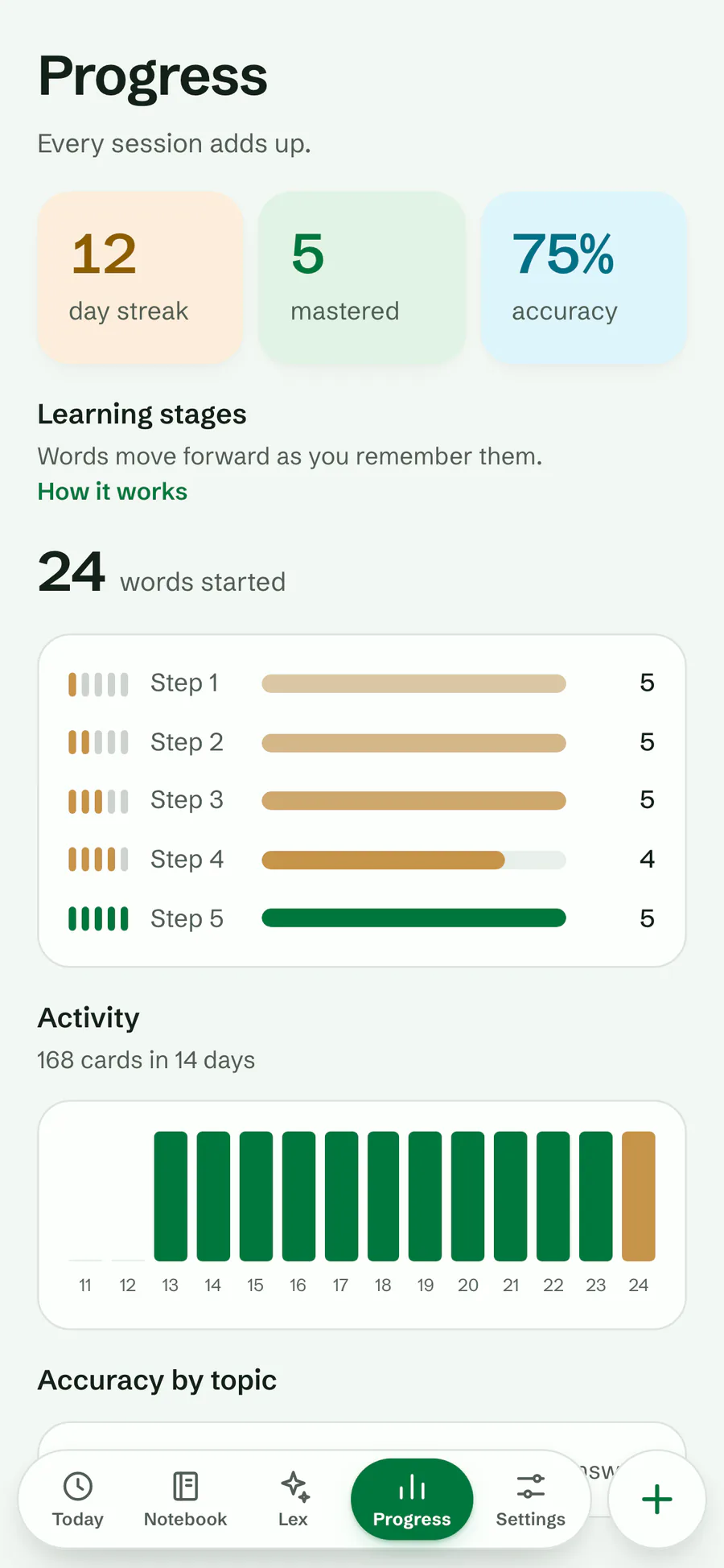
Lexpad calls the boxes steps, so the app shows “Step 2 of 5”.
- A new word starts in step 1 and is asked today.
- Answer it right and it moves up one step: step 2 waits 1 day, step 3 3 days, step 4 7 days, step 5 21 days.
- Get it wrong and it goes back to step 1, to be asked again today.
- Step 5 counts as mastered. The word comes back after 21 days, then after 45, 90, 180 and 365 days as long as you know it, and then once a year.
- Miss a mastered word and it goes back to step 1 like any other, to be asked again today.
- Days follow your own time zone.
So a word you know every time is seen today, then after 1, 3 and 7 more days, and reaches step 5 in under two weeks.
How to make a paper Leitner box, or use an app
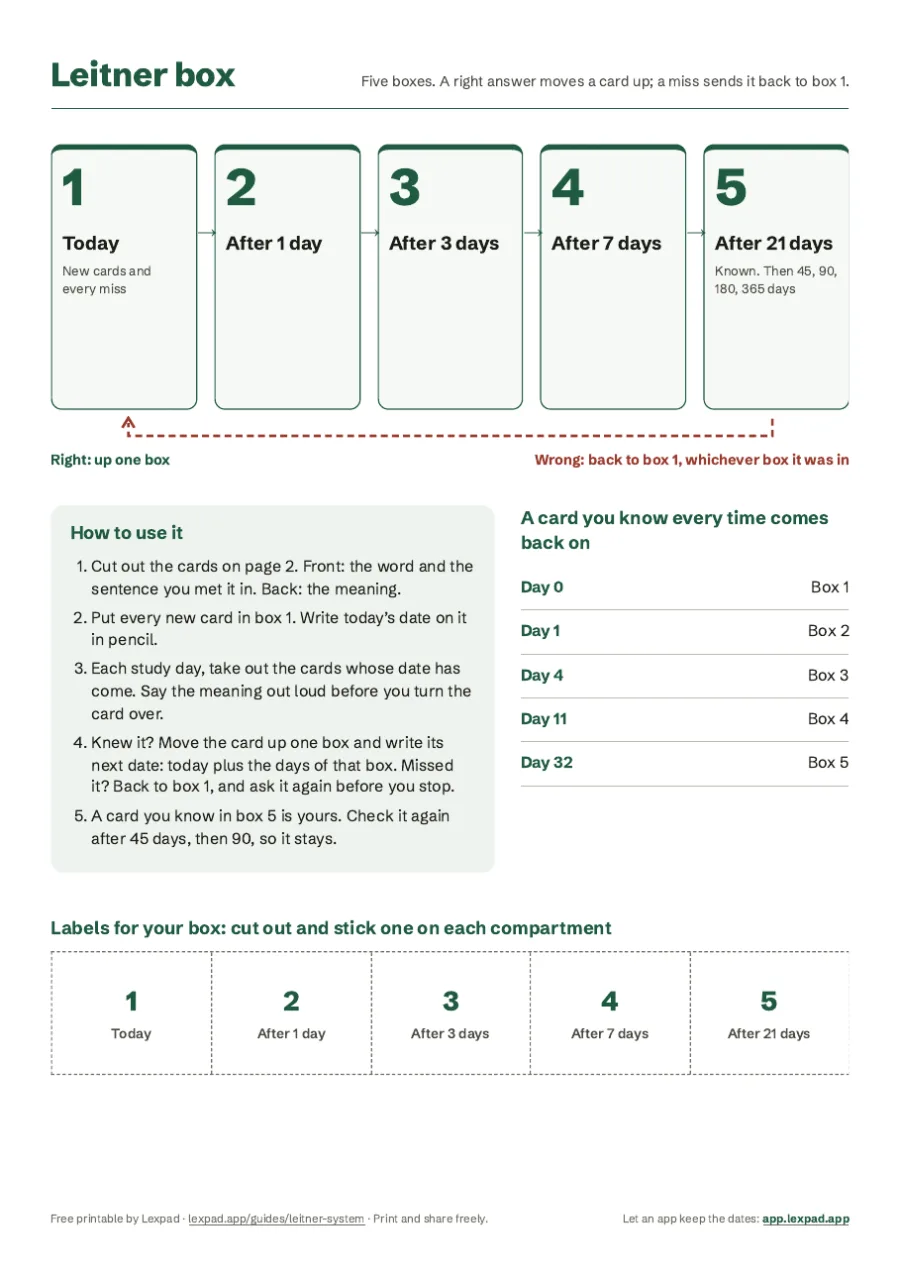
You need index cards and a box with five compartments: a shoebox with four dividers, or five envelopes.
- Number the compartments 1 to 5.
- Write the word on the front of a card, and its meaning and the sentence you met it in on the back.
- Put every new card in box 1.
- Each study day, take out the cards that are due and say the meaning before you turn each one over.
- Right: the card moves up one box. Wrong: it goes back to box 1, whichever box it was in.
On paper, the hard part is knowing which cards are due. Two simple ways: when you move a card, write its next date on it in pencil (today plus 1, 3, 7 or 21 days for boxes 2 to 5), or give each box its own days, with box 1 every day and each higher box less often.
A paper box works, and some people love it. What an app adds is the bookkeeping: it knows which box each word is in and which are due today, it never loses a card, and it can vary the question so a word is not always shown the same way.
In Lexpad, new words start with recognition cards (see the word, recall its meaning); typed recall and spelling unlock once a word reaches step 2. Words you keep mixing up come back together in the Confusables deck.
Prefer a notebook to cards? The free vocabulary notebook template uses the same review days on paper.
Print a Leitner box: free PDF
A two-page PDF to start a paper Leitner box today. Page 1 shows five boxes with the days each one waits, the rule, and five labels to cut out and stick on your compartments. Page 2 is a sheet of flashcards to cut out, A7 size, with a line for the word, two for the sentence you met it in, and boxes to mark which box the card is in and its next date.
- A4 PDF: eight A7 cards on page 2 (most countries)
- US Letter PDF: six A7 cards on page 2 (United States, Canada, Mexico)
Print page 2 as often as you need cards. Write the meaning on the back by hand. Free to print and copy for yourself or a class.
Leitner system vs Anki
The Leitner system gives each box a fixed wait, so you can always see why a card is back today. Anki works out a wait for each card from your answers: with its older SM-2 method, or with FSRS once you turn it on in the deck options (Anki manual, deck options (FSRS)). Anki asks you to grade each answer Again, Hard, Good or Easy; a Leitner box needs only right or wrong.
Paper boxes suit a small set of cards and people who like a rule they can see. Anki suits large decks of any subject, with card templates and add-ons. Lexpad uses Leitner boxes by default and lets any notebook switch to a per-word schedule built on FSRS (Beta). Leitner boxes or FSRS compares the two kinds of schedule, and Lexpad vs Anki compares the apps.
Anki facts read on 14 October 2026 in the Anki manual.
Your own rules
The five steps are the default in every Lexpad notebook, and most people never change them. Each notebook can, on its How words come back page:
- Go back two boxes after a miss instead of starting over, so step 5 drops to step 3.
- Only due words move (on by default): practising a word before its day keeps its step, so extra practice never pushes a word up too early.
- A daily limit on reviews, for the days after a break.
- The Smart schedule (Beta), which works out a gap for each word from your own answers, built on FSRS. Leitner boxes or FSRS compares the two.
Making it work
- Keep sessions short and daily. A few minutes a day beats an hour once a week. How many new words a day works out the load.
- Add words you actually met, with the sentence you met them in. Your own words are easier to remember than a list.
- Be honest when you answer. Moving a word up when you were not sure only brings it back later, when it is harder.
- Do not worry about missed days. Nothing is lost; due words simply wait for you.
Keeping the words in a notebook first? How to keep a vocabulary notebook that works.
A free Leitner box app for Windows, Mac, Android and iPhone
Lexpad runs the Leitner boxes for you, free, on your phone or computer, or online in your browser at app.lexpad.app. It is one notebook and one schedule on every device, and your answers sync.
- Web: app.lexpad.app in any modern browser, nothing to install; saved words and practice work offline.
- Android: Google Play, or a direct download.
- Mac and Windows: a desktop app with the whole app in a window, plus a shortcut that saves a word from any app.
- iPhone and iPad: The iPhone and iPad app is on the App Store, and Lexpad also works in Safari.
Good to know
Questions
How many boxes should a Leitner system have?
Five is the most common choice, and the one Lexpad uses.
How do you make a Leitner box?
Use a box with five compartments, numbered 1 to 5, and one card per word. New cards start in box 1. A right answer moves a card up one box; a wrong one sends it back to box 1. Higher boxes wait longer: in Lexpad, 1, 3, 7 and 21 days for steps 2 to 5.
What happens to a word on step 5?
In Lexpad it counts as mastered. It comes back after 21 days, and each time you know it the wait grows: 45, 90, 180, then 365 days. If you miss it, it goes back to step 1.
Is the Leitner system the same as spaced repetition?
It is one of the simplest kinds. Other methods calculate a different interval for each card; the Leitner system uses fixed boxes, which makes it easy to understand and trust. Lexpad offers both: Boxes by default, and Smart (Beta) for a notebook where you want gaps worked out per word. Spaced repetition for vocabulary explains the main kinds.
Leitner system or Anki?
The Leitner system uses a few fixed boxes you can see. Anki uses an algorithm that sets a wait for each card (its FSRS scheduler is turned on in the deck options). Lexpad offers both kinds: Boxes by default, or the Smart schedule built on FSRS-6 (Beta), per notebook. Leitner boxes or FSRS compares them.
Is there a free Leitner box app for Windows or Android?
Yes. Lexpad runs the Leitner boxes free on the web, on Android and in its desktop app for Windows and Mac.
Lexpad
Keep the words you meet this week.
Lexpad is free to start, on the web and on Android. Bring the words you meet.