 Lexpad
Memorize vocabularyHow to memorize vocabulary
and keep it
To memorize vocabulary for good, take words from what you read and hear, test yourself on them instead of rereading them, and space the tests out over days and weeks, with longer gaps for the words you already know. Keep each word with the sentence you met it in, add only as many new words a day as you can review, and spend a few minutes on it every day.
By Reza Pirighadim, who makes Lexpad. Checked against the app on 13 October 2026.
- Rule 1
- Meet it in a sentence
- Rule 2
- Test, do not reread
- Rule 3
- Gaps that grow
- Daily
- A few minutes
The short answer
- Meet the word in context. Keep the words you find yourself, with the sentence they were in.
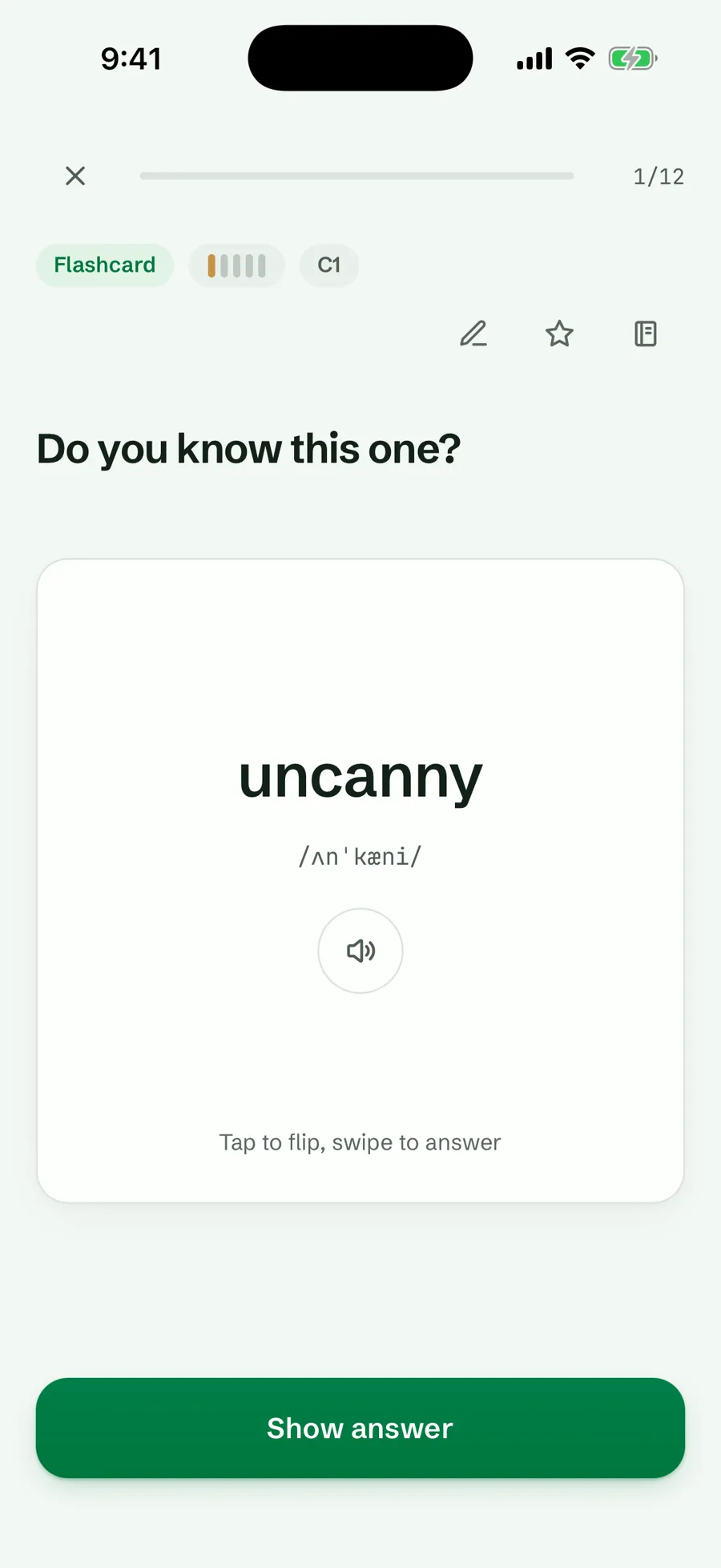
- Test yourself. Cover the meaning and try to recall it, or see the meaning and recall the word. Do not just read the list again.
- Space the tests. See a word again after a day, then after a few days, then after weeks. A word you miss comes back sooner.
Two of these are the best-supported study methods there are. A large review of ten common study techniques rated only two of them “high utility”: practice testing and distributed (spaced) practice. Rereading and highlighting were rated low (Dunlosky et al., 2013).
Test yourself, do not reread
Rereading a list feels like work, and it feels as if it works. It does little. In a well-known experiment, students learned Swahili–English word pairs. Once a pair was learned, studying it again had no measurable effect on recall a week later, while testing it again had a large one (Karpicke and Roediger, 2008, Science).
- Cover the meaning and say it, or write it, before you look.
- Test both ways: word to meaning, and meaning to word. Recalling the word is harder, and it is what you need to use it.
- Be honest about misses. A miss is information: that word needs to come back sooner.
- Type or spell the hard ones. Spelling is a separate thing to remember.
Space the reviews
Reviews spread over days beat the same number of reviews crammed into one sitting. A review of 317 experiments found this again and again, and found that the best gap grows with how long you want to remember: for a test tomorrow, short gaps; for good, longer ones (Cepeda et al., 2006).
So the gaps should grow as you learn a word. The simplest rule is the Leitner box: a word you know waits longer before it comes back; a word you miss starts again.
- Box 1Today
- Box 21 day
- Box 33 days
- Box 47 days
- Box 5 · mastered21 days, then longer
These are the waits in Lexpad’s five boxes; a mastered word then waits 45, 90, 180 and 365 days while you know it. The Leitner system explained. A schedule that sets a gap for each word is the other way: Leitner boxes or FSRS. Spaced repetition for vocabulary explains the schedules and which apps use them.
Keep the word in its sentence
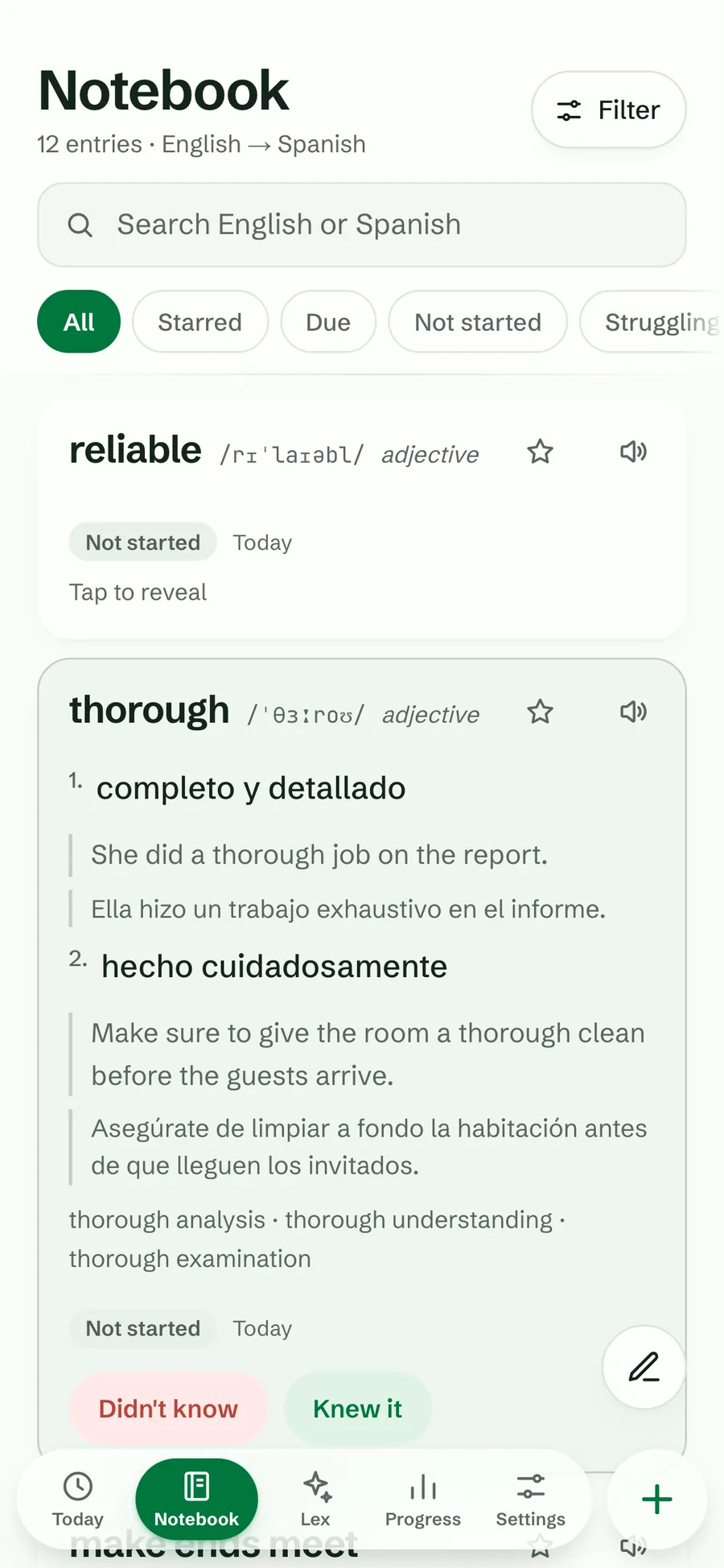
A word on its own is easy to forget and easy to misuse. The sentence you met it in shows how it behaves: the words around it, how formal it is, which of its meanings you met. When the word comes back, the sentence brings back the moment you saw it, and it is a ready example.
- Write the word in the form you will use: “give up”, not “gave up”.
- One clear meaning beats five you will not read. Add others when you meet them.
- A short note of where you met it (a book, a series, a meeting) is a strong hook.
How to keep a vocabulary notebook has a simple layout for each word.
How many words at once
The limit is not the new words. It is the reviews each one brings. With a growing-gap schedule, a word you know every time is seen about five times in its first month. So 15 new words a day means about 75 reviews a day after a month, before any misses.
Start small, about 10 to 15 new words a day, and raise it only if your daily reviews stay easy. How many new words a day shows the arithmetic, and the free spaced repetition calculator works out your own.
On paper
- Write each word on a card: the word and its sentence on the front, the meaning on the back.
- Keep five piles or a box with five compartments. New cards go in the first.
- Each day, test the piles that are due. A card you know moves up a pile; a card you miss goes back to the first.
- Review pile 1 every day, and the higher piles less and less often.
It costs nothing and has no screen. Its weak point is the bookkeeping: you decide what is due, and nothing reminds you.
In an app
An app does the bookkeeping: it knows which words are due today, brings missed words back sooner, and can ask the same word in different ways. This is how Lexpad, our own app, runs the three rules:
- Context: save a word with its sentence from a web page or from any app on a computer, or pick words out of a pasted text. Fill with AI writes meanings, examples and pronunciation; you can change anything.
- Testing: Today brings the words that are due. New words start with recognition; recall (meaning to word) and spelling join once a word reaches box 2. The notebook itself turns into a quiz when you switch Meanings off.
- Spacing: five Leitner boxes by default, or the Smart schedule (Beta), which works out a gap for each word. Up to 15 new words a day join your practice by default.
Words come from you: Lexpad has no word lists. The notebook, both schedules and every card type are on the free plan.
Memory tricks
A memory trick can help with one stubborn word: a picture in words, a sound-alike in your own language (the keyword method), a sentence about your own life. Use them for the words that keep slipping, not for every word. In the review above, the keyword method was rated low utility overall, though it has helped learners with vocabulary that suits it (Dunlosky et al., 2013).
In Lexpad, a word you miss on many different days gets a question at the end of a session, with Add a note as one answer: a good place for the trick.
Common mistakes
- Rereading instead of recalling. If you can see the answer, you are not testing yourself.
- Cramming. A long session the night before works for the next day and fades soon after.
- Copying lists. Words from a list someone else made have no story. Keep the ones you met.
- Adding more than you can review. Fifty new words a day turns into hundreds of reviews within a month.
- Skipping days, then quitting. A missed day loses nothing. Come back and start with what is due.
By language
The method is the same in every language; what goes on each card is not. Guides for one language at a time:
- How to learn Spanish vocabulary: the article with every noun, cognates and false friends, accents that change meaning.
- How to learn Japanese vocabulary: words rather than lone kanji, the reading on every card, homophones.
Good to know
Questions
What is the fastest way to memorize vocabulary?
There is no shortcut that lasts. What works best per minute is testing yourself and spacing the tests: a few minutes a day, with longer gaps for the words you know. Cramming is fast for tomorrow and fades soon after.
How many times do I need to review a word?
It depends on the word and how long you want it. On Lexpad’s box schedule, a word you know every time is seen on days 0, 1, 4, 11 and 32, then after longer and longer gaps. Every miss adds a few more.
Should I learn words from a list?
Words you met yourself, with their sentence, are easier to keep and more useful to you. A list is fine for an exam syllabus, but test and space it the same way.
Is writing words by hand enough?
Writing a word helps you notice it, but it is not a review. Testing yourself later, with growing gaps, is what keeps it.
How long should I study vocabulary a day?
A few minutes every day beats an hour once a week. If your daily reviews grow too long, add fewer new words for a while.
Lexpad
Your next word is worth keeping.
Lexpad is free to start, on the web and on Android. Bring the words you meet.