 Lexpad
Spanish · Gender, cognates, accentsHow to learn
Spanish vocabulary
Spanish words are friendly to English speakers, because thousands share a Latin root, but every noun has a gender, some look-alikes mean something else, and an accent can change a word. Save each word you meet with its article and its sentence, note the trap it holds, and review it on a spaced schedule.
By Reza Pirighadim, who makes Lexpad. Checked against the app on 21 October 2026.
The short answer
- Save the phrase you met, not just the word: the noun with el or la, the verb with its preposition (pensar en, depender de).
- Use cognates, but check them: -ción words are usually what they look like; embarazada is not.
- Review on a schedule: a few words a day, seen again after 1, 3, 7 and 21 days, beat long lists read once.
What makes Spanish words easy, and hard
Four things decide how a Spanish word should go into your notebook.
Every noun has a gender
A noun is masculine or feminine, and the article, adjectives and pronouns follow it. Endings help: most nouns in -o are masculine and most in -a are feminine; nouns in -ción, -sión, -dad and -tud are feminine. The exceptions are common words, which is why the article belongs on the card: el día and el mapa are masculine, la mano is feminine, and many words of Greek origin in -ma are masculine (el problema, el tema).
One rule looks like an exception: a feminine noun that starts with a stressed a sound takes el in the singular, but stays feminine. So it is el agua fría and las aguas, el águila and el hacha (Real Academia Española, Diccionario panhispánico de dudas, “el”). Save it as el agua (f.).
Cognates are a head start
Many English words of Latin origin have Spanish forms that follow patterns: -tion often becomes -ción (nation, nación), -ity becomes -idad (possibility, posibilidad), and -ous becomes -oso (famous, famoso). These words are cheap to learn: you need the pattern and the gender more than the meaning. Spend your reviews on the words that do not follow a pattern.
False friends cost the most
Some words look English and mean something else. Embarazada means pregnant, not embarrassed; actualmente means currently, not actually; a librería is a bookshop (a library is a biblioteca); and in Spain constipado means having a cold (Real Academia Española, Diccionario de la lengua española). Give each one its own card, with the meaning you expected in the usage note, because the wrong meaning will keep coming back until the right one is practised.
Accents change words
Ñ is a letter of its own, so año (year) and ano (anus) are different words. A written accent can separate two words that sound alike: sí (yes) and si (if), tú (you) and tu (your), él (he) and el (the) (RAE, Diccionario panhispánico de dudas, “tilde”). Copy words with their accents from the text you read, and type them that way.
Spain or Latin America
Everyday words differ between countries: a car is a coche in Spain and a carro or auto in much of Latin America; a computer is an ordenador in Spain and a computadora in Latin America; a mobile phone is a móvil or a celular. Pick the variety you hear most and save its word as the main one; add the other in the usage note when you meet it. Both are correct Spanish.
What to put on each card
A Spanish card needs one or two things an English one does not. Here is the layout, using the fields of a Lexpad card; the same works on paper or in any flashcard app.
| Field | What to write | Example |
|---|---|---|
| Word | The noun with its article, the verb with the preposition it takes, or the whole phrase you met. | el día · soñar con · echar de menos |
| Meaning | The meaning in your language, for the sense you met. | to dream about |
| Example | The sentence you met it in, copied as it was. | Anoche soñé con el mar. |
| Usage note | What would trip you up: an unexpected gender, a false friend, a region. | Masculine, although it ends in -a. · Spain; computadora in Latin America. |
| Plural | Only when it changes more than an added -s. | el lápiz → los lápices |
Where to find your words
- Graded readers written for learners at your level: you meet a few new words a page, in a story you can follow.
- News in Spanish, such as BBC Mundo or RTVE, read slowly: one article a day gives more words than you can keep.
- Series and films with Spanish subtitles, so you can see a word you heard. Pause and save the line.
- Your class or textbook: the words your teacher uses again are the ones you will need.
Pick only the words you met and want to use. To pick words from a text you are reading, paste it into the free text to flashcards tool and tap the ones you don’t know.
How many Spanish words a day
Most learners keep 10 to 15 new words a day going; the reviews they bring are the real cost. Try your own numbers in the spaced repetition calculator, and see roughly how many words each level is estimated to need in CEFR levels for vocabulary. The method itself, step by step: How to memorize vocabulary.
How Lexpad helps with Spanish
Made by the author of this page
A Spanish notebook in Lexpad
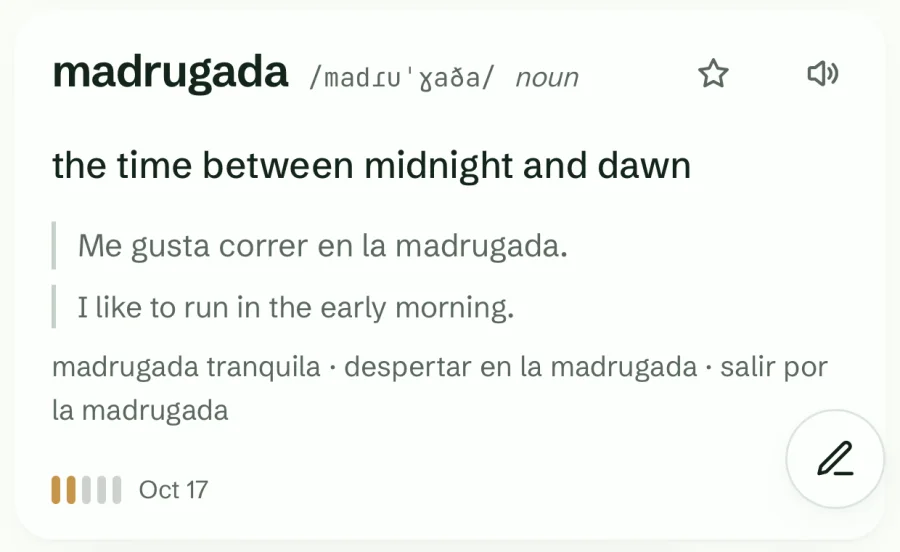
- Type el día or la mano and the card keeps it exactly as you wrote it, article included, while AI writes the meanings, examples, IPA, part of speech, a CEFR level and the usual collocations.
- Año and ano are two different words in a Lexpad notebook. La mano and mano are two entries too, so choose one way (with the article) and keep to it.
- Typing answers ignore accents, the tilde of ñ included: a drill will not mark ano wrong for año. Check your accents when the card turns over.
- Write the region or the false friend in the usage note, in More details.
- Save words from Spanish websites with the browser extension, or from a Kindle book with its own import. The app’s own screens are in English.
Free account, no card. Apps: Mac · Windows · Android · iPhone
Free account, no card. macOS 11 or later · All downloads

Free account, no card. Or the direct installer
Free account, no card. Or the APK file
Free account, no card. The iPhone app is coming to the App Store. The web app works in Safari today.
Free account, no card. The iPhone app is coming to the App Store. The web app works in Safari today.
 Add to Chrome
Free account, no card. Apps: Mac · Windows · Android · iPhone
 Add to Edge
Free account, no card. Apps: Mac · Windows · Android · iPhone
 Add to Firefox
Free account, no card. Apps: Mac · Windows · Android · iPhone
Good to know
Questions
How can I learn Spanish words fast?
Learn fewer, better: words you met, with their article and sentence, reviewed on a spaced schedule. Cognates are fast; false friends and gender take the reviews.
How many Spanish words do I need?
It depends on your goal. For English, researchers estimate a few thousand words for B1 and more for B2; Spanish has no exact table. See CEFR levels for vocabulary.
Should I learn Spain or Latin American Spanish words?
The variety you will hear most. The grammar is shared; some everyday words differ. Save the other word in a note when you meet it.
Should I learn Spanish vocabulary from lists?
A list can show you what exists, but words you met in context stay better, because the sentence is part of the memory. Lexpad never gives you a list: you bring your own words.
Do I need to learn the gender of every noun?
Yes, with the article, from the start. The endings help, and the common exceptions are the words worth a note.
Lexpad
Start your Spanish notebook.
Save the words you meet with their sentence; AI writes the card and spaced repetition brings each one back. Free to start, on the web, Android, Mac and Windows.
Every new account gets Pro free for 14 days, no card needed.
Free account, no card. Apps: Mac · Windows · Android · iPhone
Free account, no card. macOS 11 or later · All downloads
Free account, no card. Or the direct installer
Free account, no card. Or the APK file
Free account, no card. The iPhone app is coming to the App Store. The web app works in Safari today.
Free account, no card. The iPhone app is coming to the App Store. The web app works in Safari today.
Free account, no card. Apps: Mac · Windows · Android · iPhone
Free account, no card. Apps: Mac · Windows · Android · iPhone
Free account, no card. Apps: Mac · Windows · Android · iPhone