Texts without spaces
Pasting Chinese, Japanese, Thai, Lao, Khmer or Burmese text splits it into words, so you can pick new words from it like any other language.
 Lexpad
Learn vocabulary in 81 languages
Lexpad does not assume you are learning English. Every notebook has a language you are learning and a language for meanings, chosen from the same 81. Any pair works, including a language through itself. The app’s own screens are in English.
Updated . Checked against the app on 3 October 2026.
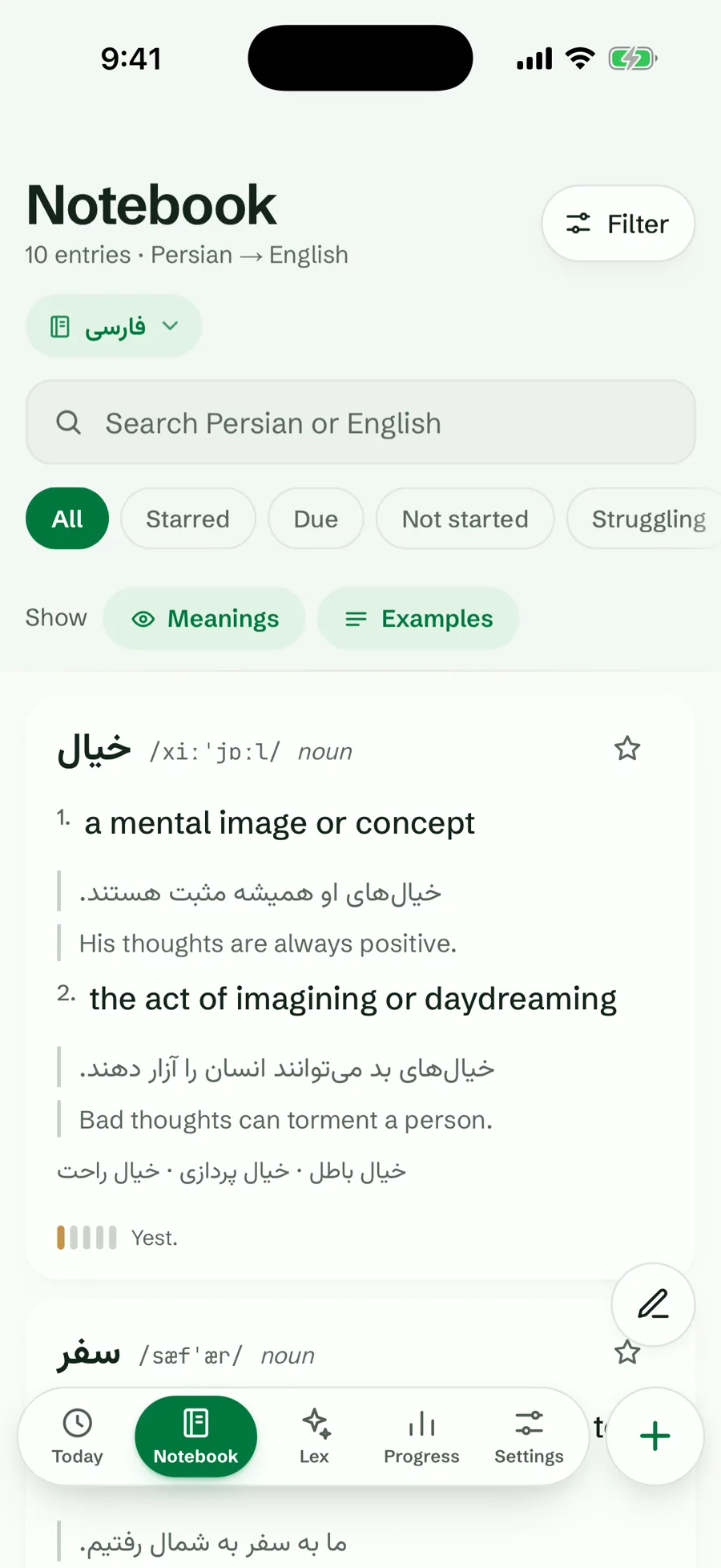
A notebook has two sides: the language you are learning and the language its meanings are written in. Any of the 81 languages can go on either side, and the same language can be on both, so there are 81 × 81 = 6,561 pairs: 6,480 with two different languages, and 81 where you learn a language through itself, such as an English notebook with English definitions.
Some pairs learners use:
Each language with its English name, its own name and the code Lexpad stores it under. Every one can be the language you learn or the language of the meanings. Grouped by region only to make the list easier to scan.
| Language | Native name | Code |
|---|---|---|
| English | English | en |
| Spanish | Español | es |
| French | Français | fr |
| German | Deutsch | de |
| Italian | Italiano | it |
| Portuguese | Português | pt |
| Dutch | Nederlands | nl |
| Swedish | Svenska | sv |
| Danish | Dansk | da |
| Norwegian | Norsk | no |
| Finnish | Suomi | fi |
| Icelandic | Íslenska | is |
| Estonian | Eesti | et |
| Latvian | Latviešu | lv |
| Lithuanian | Lietuvių | lt |
| Polish | Polski | pl |
| Czech | Čeština | cs |
| Slovak | Slovenčina | sk |
| Hungarian | Magyar | hu |
| Romanian | Română | ro |
| Bulgarian | Български | bg |
| Greek | Ελληνικά | el |
| Russian | Русский | ru |
| Ukrainian | Українська | uk |
| Belarusian | Беларуская | be |
| Serbian | Српски | sr |
| Croatian | Hrvatski | hr |
| Bosnian | Bosanski | bs |
| Slovenian | Slovenščina | sl |
| Macedonian | Македонски | mk |
| Albanian | Shqip | sq |
| Catalan | Català | ca |
| Galician | Galego | gl |
| Basque | Euskara | eu |
| Irish | Gaeilge | ga |
| Welsh | Cymraeg | cy |
| Maltese | Malti | mt |
| Language | Native name | Code |
|---|---|---|
| Turkish | Türkçe | tr |
| Arabic | العربية | ar |
| Persian | فارسی | fa |
| Hebrew | עברית | he |
| Kurdish | Kurdî | ku |
| Pashto | پښتو | ps |
| Azerbaijani | Azərbaycanca | az |
| Armenian | Հայերեն | hy |
| Georgian | ქართული | ka |
| Kazakh | Қазақша | kk |
| Uzbek | Oʻzbekcha | uz |
| Kyrgyz | Кыргызча | ky |
| Tajik | Тоҷикӣ | tg |
| Language | Native name | Code |
|---|---|---|
| Hindi | हिन्दी | hi |
| Urdu | اردو | ur |
| Bengali | বাংলা | bn |
| Punjabi | ਪੰਜਾਬੀ | pa |
| Gujarati | ગુજરાતી | gu |
| Marathi | मराठी | mr |
| Nepali | नेपाली | ne |
| Sinhala | සිංහල | si |
| Tamil | தமிழ் | ta |
| Telugu | తెలుగు | te |
| Kannada | ಕನ್ನಡ | kn |
| Malayalam | മലയാളം | ml |
| Language | Native name | Code |
|---|---|---|
| Chinese | 中文 | zh |
| Japanese | 日本語 | ja |
| Korean | 한국어 | ko |
| Vietnamese | Tiếng Việt | vi |
| Thai | ไทย | th |
| Lao | ລາວ | lo |
| Khmer | ខ្មែរ | km |
| Burmese | မြန်မာ | my |
| Indonesian | Bahasa Indonesia | id |
| Malay | Bahasa Melayu | ms |
| Filipino | Filipino | tl |
| Language | Native name | Code |
|---|---|---|
| Swahili | Kiswahili | sw |
| Amharic | አማርኛ | am |
| Hausa | Hausa | ha |
| Yoruba | Yorùbá | yo |
| Igbo | Igbo | ig |
| Zulu | isiZulu | zu |
| Afrikaans | Afrikaans | af |
| Somali | Soomaali | so |
Choose the same language twice and the AI writes the card the way a learner’s dictionary does: each meaning is a short, simple definition in that language, with a plain synonym where one exists, and each example comes with a plain-words paraphrase instead of a translation.
A way to use it for your own language: how to build your vocabulary as an adult.
Arabic, Persian, Hebrew, Urdu and Pashto read right to left. Direction is set for each piece of text, not for the whole screen, so an English word with a Persian meaning shows each side the right way round. Text you type takes its direction from its first letter. Kurdish is written in Latin script, left to right.
Arabic speakers learning English can read about Lexpad in Arabic.
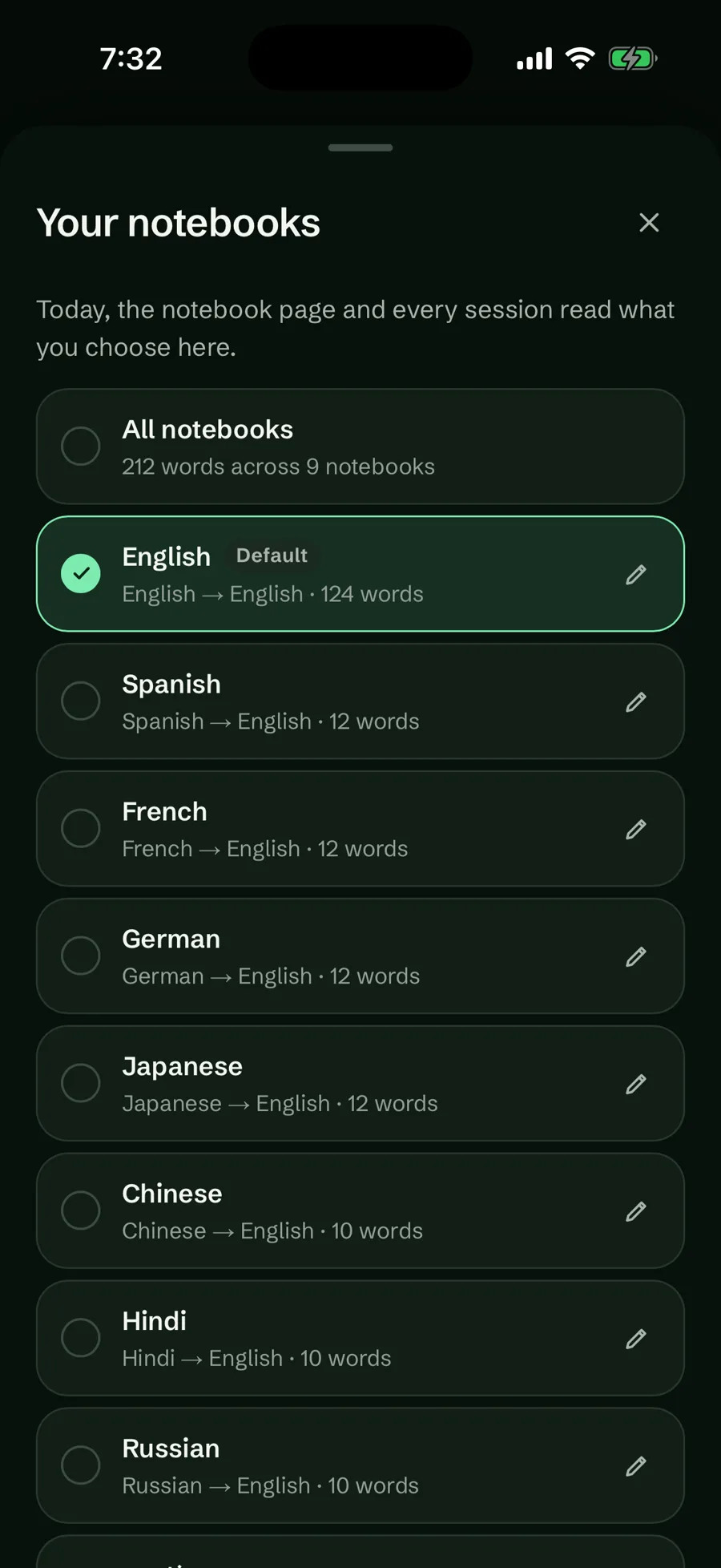
Prefer another look? Each notebook can have its own font, one for its words and one for its meanings. Open Edit notebook, then Fonts, or on a word’s page More, then Font for this notebook. Arabic, for example, can also be Noto Sans Arabic, Vazirmatn or Noto Kufi Arabic. Only that notebook changes, and the choice is saved to your account. In the web app, the iPhone and Android apps from 1.0.95 and Lexpad for Mac and Windows from 0.3.36.
The fonts are served by Lexpad itself, never from a font service. On the web, each one downloads the first time its script appears, so you only fetch what you read; the Android app carries them all and works offline. A font you pick for a notebook may need a connection the first time. Letter spacing is applied only to Latin, Cyrillic and Greek, so Arabic letters stay joined and Indic conjuncts stay whole.
Samples on this page use the fonts this website carries or your device’s own; the app uses the faces named.
Small rules that keep every language right.
Pasting Chinese, Japanese, Thai, Lao, Khmer or Burmese text splits it into words, so you can pick new words from it like any other language.
AI cards give pronunciation in IPA for every language, Chinese and Japanese too; Lexpad does not write pinyin or furigana. When you import an Anki deck, a pinyin, zhuyin, furigana or romaji field comes in as the word’s pronunciation.
With Pro, a natural voice reads words in 74 languages, and you choose it for each one (how). Otherwise the speaker uses your device’s voices in each language’s own locale. Where a device has no voice for a language, the speaker button and the Audio deck do not appear.
Lexpad reads a word’s writing system: Arabic letters go to a notebook that can hold them, kana to a Japanese one. When two notebooks share a script, it asks instead of guessing.
Letters that change a word are kept: “año” and “ano”, “schön” and “schon” are different words, and so are Thai and Indic words that differ by a vowel mark. Search forgives accents, so “cafe” still finds “café”.
How to learn the words of one language, with what to save on each card: Spanish, Japanese, French, Italian, German and Korean so far.
AI cards, Words worth keeping and Lex work in every pair, but Lexpad makes no claim that every pair is equally good. Check each card, use Refine or edit it by hand, and Report a card that is wrong.
Good to know
Yes. Pick Japanese as the language you learn and Spanish for the meanings. All 6,561 pairs of the 81 languages work, in both directions.
No promise of that. Lexpad has not measured card quality pair by pair and makes no quality claim for any language. Check each card, change anything that is off, and use Report so the team can fix a bad card for everyone.
Both. Choose English as the language you learn and Persian for meanings, or the other way round. Each side of the card keeps its own direction: Persian right to left, English left to right. Persian notebooks follow the same Free and Pro plans as every other language.
Yes. Choose the same language on both sides, English and English for example, and every meaning is a simple definition in that language instead of a translation.
Lexpad treats Kurdish as Latin script, left to right.
Lexpad
Lexpad is free to start, on the web and on Android. Bring the words you meet.