 Lexpad
Method · Your own language
How to build your vocabulary
as an adult
Adults keep learning words all their lives, but slowly, and mostly by chance. If you want to grow your vocabulary on purpose, in your own language or in one you already speak well, the method is short: read a little above your level, keep the words you meet with their sentence and a plain definition, and bring them back until they are yours.
By Reza Pirighadim, who makes Lexpad. Checked against the app on 25 October 2026.
How adults gain words
An average 20-year-old native speaker of American English knows about 42,000 lemmas, and between 20 and 60 people learn about 6,000 more, roughly one every two days (Brysbaert and colleagues, Frontiers in Psychology 7, 2016). Almost all of them come from reading and listening, not from study.
That route is slow for any single word. A meta-analysis of 20 experiments found that readers learn about 15% of the unknown words they meet in normal reading (Swanborn and de Glopper, Review of Educational Research 69(3), 1999). Most unfamiliar words need several meetings before they stay. Building a vocabulary on purpose means giving the words you care about those meetings, instead of waiting for chance.
Read a little above your level
- Choose writing with more words than you use. Long-form journalism, essays, good novels, and the serious end of your own field. Social media and news headlines repeat the words you already know.
- Aim for a page with a few new words, not dozens. If every paragraph has one word you would look up, the level is right; if every line does, the text is too hard to learn from.
- Read regularly. Twenty minutes a day meets far more words than a weekend binge, and brings back the ones you met last week.
- Listen too. Podcasts, lectures and talks bring the spoken words that print rarely uses.
Keep the words you meet
This is the step most advice skips. A word you looked up and moved on from is usually gone within a week. Write it down, with three things:
- The word in its dictionary form: obfuscate, not obfuscated.
- A plain definition in the same language, in simpler words than the word itself. A learner’s dictionary writes definitions this way; a thesaurus synonym alone is too vague.
- The sentence you met it in. It shows how the word is used, what it goes with, and its tone.
Keep a few, not every unfamiliar word: the ones you would like to use, or that you met twice. Five a week, kept and reviewed, beats fifty skimmed. More on the notebook itself: Vocabulary notebook: how to make one.
Learn the parts
Many longer English words are built from Latin and Greek parts. Knowing a few helps you guess a new word and remember it:
- bene- (well): benefit, benevolent, benign.
- -cracy (rule by): democracy, bureaucracy, meritocracy.
- mis- (wrongly): misread, misjudge, misnomer.
Treat parts as clues, not proof: inflammable means the same as flammable. Check the dictionary, and keep the definition you find.
Use them, then review them
- Use a new word within the week. In an e-mail, a message, a conversation. Using a word moves it from words you recognise to words you reach for.
- Test yourself from the definition. See “to make something unclear on purpose” and find obfuscate. Recalling a word does more for memory than rereading it; active recall for vocabulary explains the research.
- Review at growing gaps. Tomorrow, in a few days, in a week, in three weeks. The forgetting curve shows why the gaps can grow.
Word-of-the-day apps or your own words
Word-of-the-day apps and newsletters are pleasant and easy: one interesting word a day, chosen for you, often with its history. They show you words; they rarely bring them back. Your own words, from your own reading, come with a sentence you remember and a reason to know them. Many people use both: a word of the day for curiosity, and a notebook for the words they want to keep.
How Lexpad helps
Made by the author of this page
An English notebook with English definitions
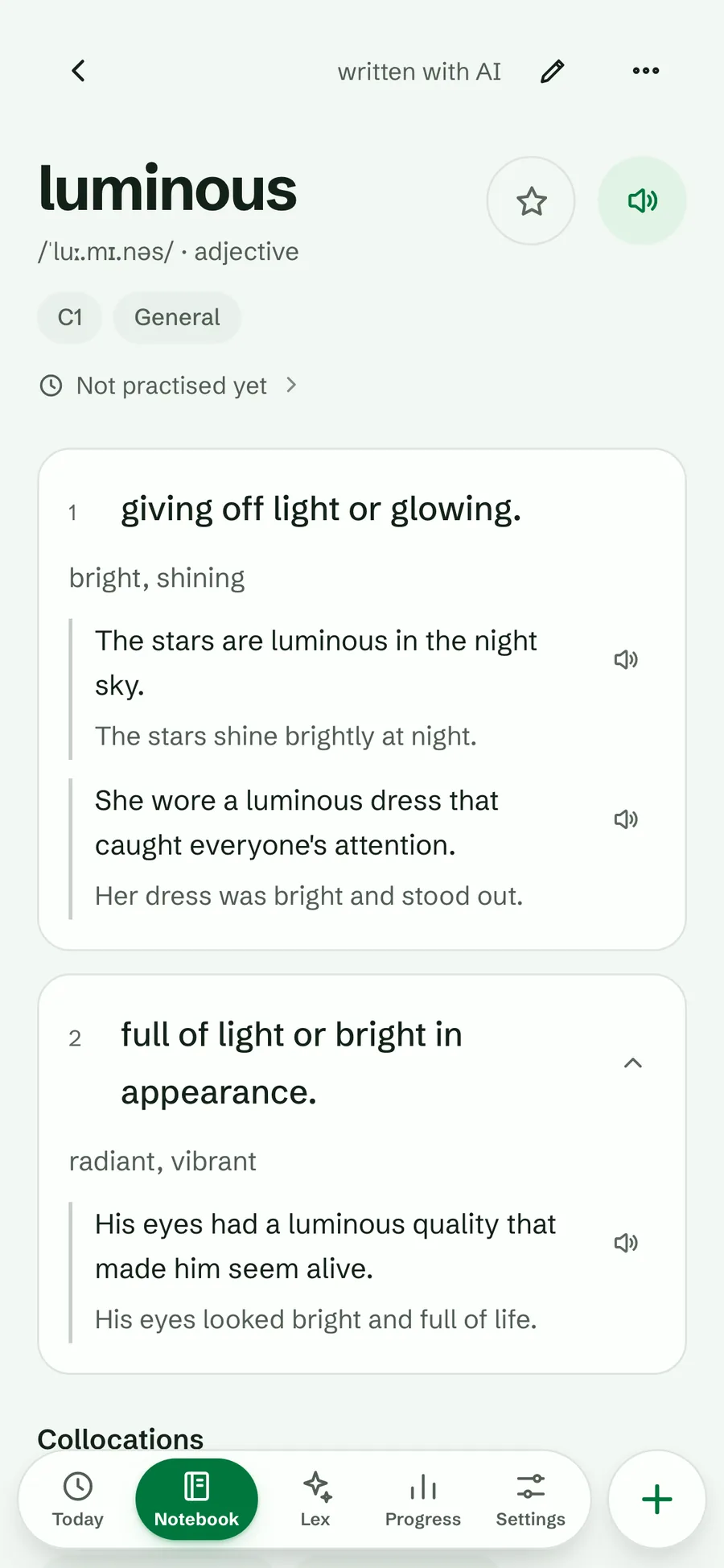
- Choose English on both sides when you create a notebook. Lexpad’s AI then writes each card the way a learner’s dictionary does: short definitions in plain English, a plain synonym where one exists, and each example with a plain-words paraphrase instead of a translation.
- It works for any of 81 languages: a French notebook with French definitions, for example.
- Save a word from any web page with the browser extension, from a Kindle, or by typing it; keep the sentence as the example.
- Five boxes bring each word back after 1, 3, 7 and 21 days while you know it, and much later once it is mastered. Cards ask from the definition as well as from the word.
Free account, no card. Apps: Mac · Windows · Android · iPhone
Free account, no card. macOS 11 or later · All downloads

Free account, no card. Or the direct installer

Free account, no card. Or the APK file
Free account, no card. Lexpad works in Safari on iPhone and iPad.
Free account, no card. Lexpad works in Safari on iPhone and iPad.
 Add to Chrome
Free account, no card. Apps: Mac · Windows · Android · iPhone
 Add to Edge
Free account, no card. Apps: Mac · Windows · Android · iPhone
 Add to Firefox
Free account, no card. Apps: Mac · Windows · Android · iPhone
Sources, read 25 October 2026
Good to know
Questions
How can an adult improve their vocabulary?
Read material a little above your level, keep the words you meet with a plain definition and their sentence, use them in writing or speech within a week, and review them at growing gaps.
Do adults still learn new words?
Yes. One large study estimated that people learn about 6,000 lemmas between 20 and 60, about one every two days, mostly from reading and listening.
Is reading enough to build vocabulary?
It is the main source, but slow for any single word: about 15% of unknown words are learned from one reading. Keeping and reviewing the words you care about makes them stay.
Should I use definitions or synonyms?
A plain definition, with a synonym as a hint. Synonyms rarely mean exactly the same, and the definition plus your sentence shows how the word is really used.
Are word-of-the-day apps useful?
For curiosity, yes. To keep words, review the ones you want on a schedule; a word you met in your own reading is easier to remember.
Lexpad
Keep the words you meet.
Save the words you meet with their sentence; AI writes the card and spaced repetition brings each one back. Free to start, on the web, Android, Mac and Windows.
Every new account gets Pro free for 7 days, no card needed.
Free account, no card. Apps: Mac · Windows · Android · iPhone
Free account, no card. macOS 11 or later · All downloads
Free account, no card. Or the direct installer
Free account, no card. Or the APK file
Free account, no card. Lexpad works in Safari on iPhone and iPad.
Free account, no card. Lexpad works in Safari on iPhone and iPad.
Free account, no card. Apps: Mac · Windows · Android · iPhone
Free account, no card. Apps: Mac · Windows · Android · iPhone
Free account, no card. Apps: Mac · Windows · Android · iPhone