 Lexpad
Words from booksHow to remember
new words from books
Mark the word without stopping, finish the page, then keep only the words worth keeping: write each with the sentence it came from and its meaning, and test yourself the next day and at growing gaps (days 1, 4, 11 and 32). Reading gives you the word in context; testing yourself is what makes it stay. On a Kindle, the Vocabulary Builder already saves your look-ups; on a computer, you can save a word from any e-book app with one shortcut.
By Reza Pirighadim, who makes Lexpad. Checked against the app on 20 October 2026.
- While reading
- Mark, do not stop
- After
- Keep 3 to 5, with the sentence
- Review
- Days 1, 4, 11, 32
- Kindle
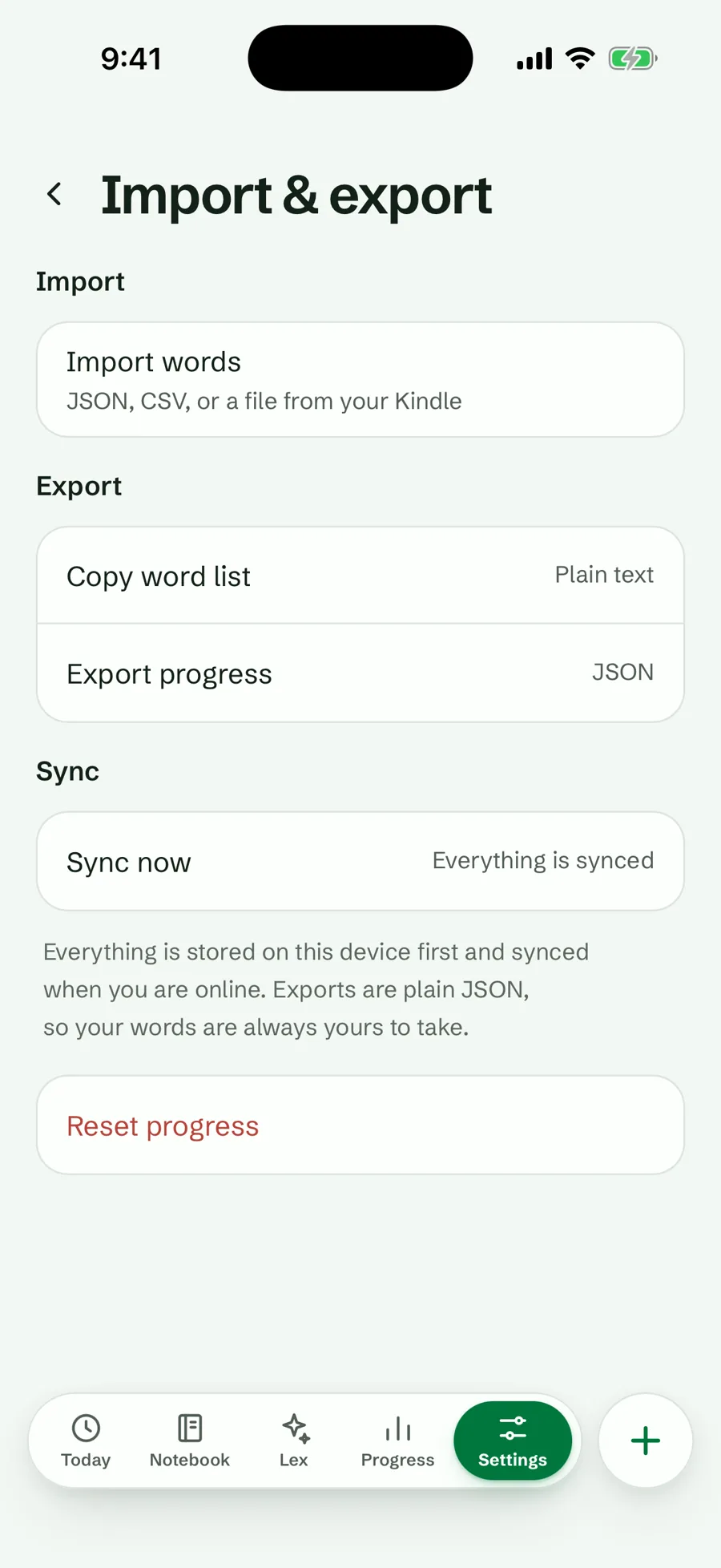
- Vocabulary Builder, then import
Why words from books slip away
You meet a new word once, understand it from the sentence or a quick look-up, and read on. A week later it is gone. Looking a word up is not the same as remembering it: the meaning was handed to you, and you never had to recall it.
Two findings explain what works instead. Recalling a word fixes it better than reading it again: students who kept testing themselves on word pairs remembered far more a week later than students who kept restudying them (Karpicke and Roediger, 2008). And reviews spread over days last longer than the same reviews crammed together (Cepeda et al., 2006).
While you read: mark, do not stop
- Guess first. Most words can be understood well enough from the sentence. Keep the story going.
- Mark the words you want. A pencil dot, a highlight, a look-up on the Kindle. It takes a second.
- Stop only when a word blocks the meaning. If you cannot follow the paragraph without it, look it up now.
- Do not mark everything. A word you will probably never meet again is not worth a card.
After the chapter: keep three to five
- Pick the words worth keeping: ones you have seen before, ones you would like to use, and phrases that surprised you.
- Write a full entry: the word in its usual form (“give up”, not “gave up”), a short meaning, the sentence from the book, and the book and page.
- Test yourself the next day: cover the meaning and recall it before you look. Then on days 4, 11 and 32. A miss starts the word again.
A whole method, with examples, is in how to make a vocabulary notebook; a printable page with these columns is the free vocabulary notebook template.
- Box 1Today
- Box 21 day
- Box 33 days
- Box 47 days
- Box 5 · mastered21 days, then longer
Paper, Kindle or e-book
The method is the same; only the capture differs.
| You read | While reading | Afterwards |
|---|---|---|
| A paper book | A pencil dot in the margin, or a sticky note; keep reading | Write the word and its sentence in your notebook, or type it into an app |
| A Kindle | Look the word up; the Kindle’s Vocabulary Builder keeps it with the sentence and the book | Export the words with their sentences using the free exporter, or import vocab.db or My Clippings.txt into Lexpad (the word and the book come across, not the sentence) |
| An e-book or PDF on a computer | Highlight it, or save it at once: in Lexpad’s desktop app, select it and press ⌘⇧L or Ctrl+Shift+L | The word is saved with its meanings and the sentence |
| An e-book on a phone | Highlight it in your reading app | Type it into your notebook later, with the sentence copied in as an example |
Doing it in Lexpad
Lexpad, our own app, does the bookkeeping. Type a word with Add a word and Fill with AI writes the meanings, examples and pronunciation; put the book’s sentence in as an example. From a Kindle, import the looked-up words in one file: the book becomes the topic, and Fill with AI completes every word in one tap. Five Leitner boxes then bring each word back, and Today shows what is due.
More on Kindle: Kindle words to flashcards. On a computer: save words from PDFs and e-books.
Good to know
Questions
How do I remember the words I read in books?
Mark them while you read, then keep a few with their sentence and meaning, and test yourself on them the next day and at growing gaps. Recalling a word fixes it far better than rereading it.
Should I look up every word I do not know?
No. Guess from the sentence and keep reading; look up only words that block the meaning, and keep only the ones you are likely to meet again.
How many new words from a book should I learn?
Three to five a chapter, or about five a day, is plenty for most people next to their reading. How many new words a day works out the review load.
How do I get the words out of my Kindle?
The Kindle’s Vocabulary Builder keeps every word you looked up, in a file called vocab.db. Our free exporter turns it into a CSV in your browser, and Lexpad imports it directly.
Does writing words down help me remember them?
Writing helps you notice the word, but it does not keep it. What keeps it is testing yourself again after a day, a few days and a few weeks.
Lexpad
Your next word is worth keeping.
Lexpad is free to start, on the web and on Android. Bring the words you meet.