 Lexpad
Japanese · Kanji, readings, kanaHow to learn
Japanese vocabulary
Japanese words are written in three scripts, a kanji can be read several ways, and many words share one sound. Save the words you meet as they were written, put the reading on the same card, keep the sentence, and review them on a spaced schedule. In Lexpad, cards give pronunciation in IPA, not furigana: you type the reading yourself.
By Reza Pirighadim, who makes Lexpad. Checked against the app on 21 October 2026.
The short answer
- Learn words, not lone kanji: the word fixes which reading a kanji has.
- Put the reading on every card, in kana, and keep the sentence you met the word in.
- Review on a schedule: a few words a day, seen again after growing gaps.
What makes Japanese words hard
Four things shape how a Japanese word should go into your notebook.
Three scripts, one sentence
Japanese mixes hiragana (grammar endings and many native words), katakana (most loanwords, such as コンピューター) and kanji (the meaning-carrying part of most words). The official list of kanji for general use, the jōyō kanji, has 2,136 characters (Agency for Cultural Affairs, Jōyō Kanji Table, 30 November 2010). Learn the kana first; then meet kanji inside words.
A kanji has several readings; a word has one
Most kanji have on readings, which came from Chinese, and kun readings, which are native Japanese. 生 is せい in 学生 (student), い in 生きる (to live) and う in 生まれる (to be born). Learning the kanji alone leaves you guessing; learning the word gives you the reading that goes with it. That is why a card should hold the word, not the character.
Many words share a sound
Japanese has many homophones. 公園 (park), 講演 (lecture) and 公演 (performance) are all read こうえん. In writing, the kanji tell them apart; in speech, the context does. Keep the sentence on the card, and when two words you know share a reading, name the other in the usage note.
Reading aids and pitch
Furigana are small kana printed beside kanji to show their reading. Texts for children and learners use them, such as NHK’s News Web Easy, which adds them over its kanji (NHK News Web Easy). Standard Japanese also has a pitch accent: in Tokyo speech, 箸 (chopsticks) and 橋 (bridge) are both はし but differ in pitch. It is worth noting on a card when two words you know differ only by pitch; most learners leave it for later.
What to put on each card
The reading is the field English cards do not need. Here is the layout, using the fields of a Lexpad card; the same works on paper or in Anki.
| Field | What to write | Example |
|---|---|---|
| Word | The word as it is written where you met it: kanji, kana or both. | 公園 |
| Pronunciation | Its reading in kana. Lexpad’s AI puts IPA here; type the reading over it, or keep both. | こうえん |
| Meaning | The meaning in your language, for the sense you met. | park |
| Example | The sentence you met it in. It tells this word apart from others that sound the same. | 公園を散歩した。 |
| Usage note | A homophone to keep apart, a politeness level, or a pitch to remember. | Not 講演 (lecture), also こうえん. |
Where to find your words
- News Web Easy from NHK: short news in simpler Japanese, with furigana over the kanji.
- Graded readers written in levels, such as the free ones from the NPO Tadoku (Tadoku).
- Manga with furigana, and series with Japanese subtitles: pause, and save the line with the word.
- Your textbook or class: its words come back in later chapters, which helps your reviews.
There is no official JLPT word list: the JLPT has published none since its 2010 revision (more on levels). Pick the words you meet. To pick them from a Japanese text, paste it into the free text to flashcards tool: your browser splits the text into words, and you tap the ones you don’t know.
Learning Japanese vocabulary without Anki
Anki is popular with Japanese learners, but it is a tool, not the method. What matters is the same anywhere: your own words, the reading on each card, the sentence, and reviews at growing gaps. A paper notebook works with a review plan (a free template); apps do the timing for you. If you already have an Anki deck, Lexpad imports it; Lexpad vs Anki compares the two honestly.
How many Japanese words a day
A new script usually brings more misses at first, so start lower than you would for a language in your own script: 5 to 10 new words a day is a good start. Try your own numbers in the spaced repetition calculator (set to miss 1 in 5, which suits a new script). The method itself: How to memorize vocabulary.
How Lexpad helps with Japanese
Made by the author of this page
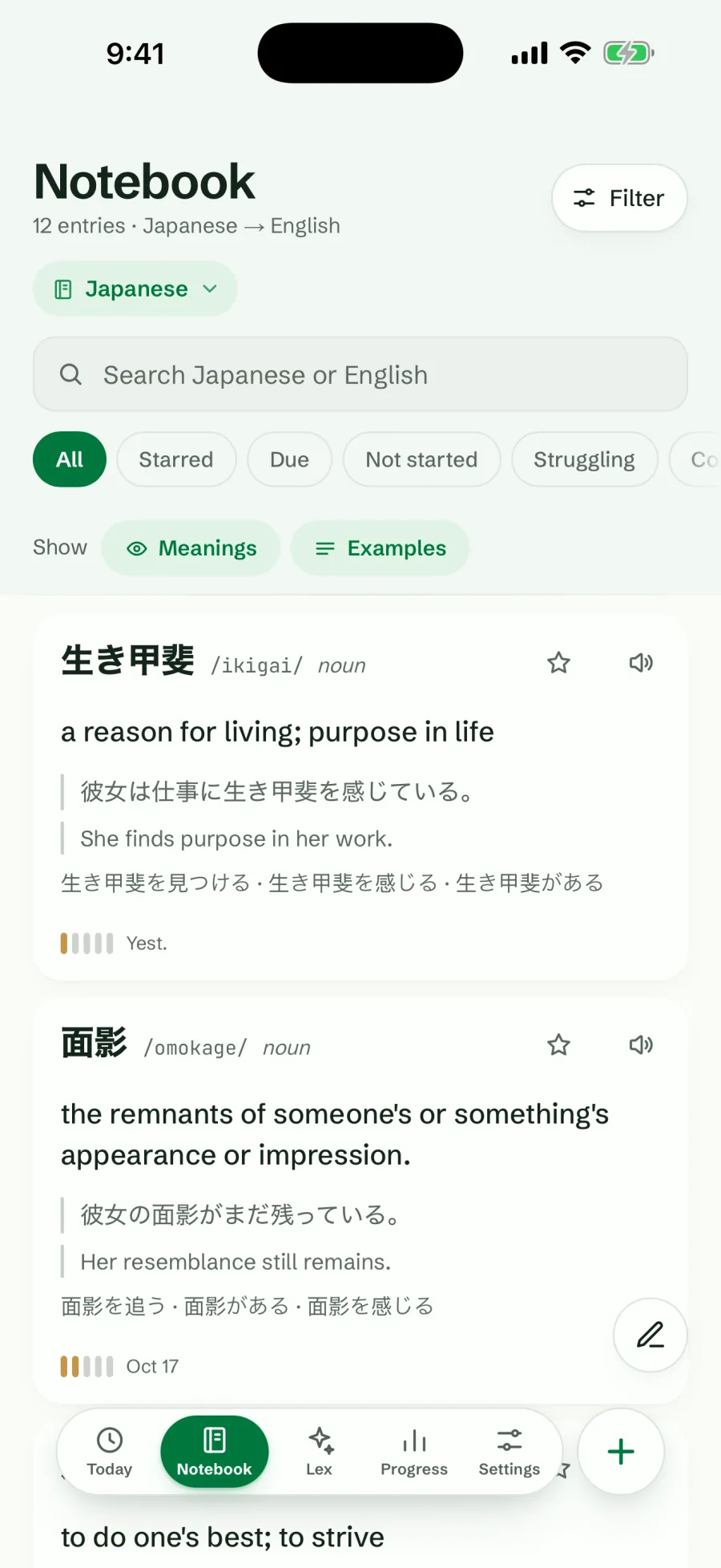
A Japanese notebook in Lexpad
- Pronunciation is IPA, not furigana. Lexpad’s AI writes IPA for every language and generates no furigana or kana reading. Type the reading yourself in Pronunciation (More details).
- Paste a text splits Japanese into words, and so does our free text tool. A browser that can only split Japanese into single characters says so, and you add the longer word by hand.
- A word in kana or kanji goes to your Japanese notebook by its writing system.
- Importing a list: a header row such as “kana, kanji, definition” is understood, and a kana column becomes the reading. An Anki deck’s reading, furigana or romaji field comes in as the pronunciation. A CSV saved in Shift_JIS is read when it holds kana.
- The app’s own screens are in English.
Free account, no card. Apps: Mac · Windows · Android · iPhone
Free account, no card. macOS 11 or later · All downloads

Free account, no card. Or the direct installer

Free account, no card. Or the APK file
Free account, no card. The iPhone app is coming to the App Store. The web app works in Safari today.
Free account, no card. The iPhone app is coming to the App Store. The web app works in Safari today.
 Add to Chrome
Free account, no card. Apps: Mac · Windows · Android · iPhone
 Add to Edge
Free account, no card. Apps: Mac · Windows · Android · iPhone
 Add to Firefox
Free account, no card. Apps: Mac · Windows · Android · iPhone
Good to know
Questions
How do I learn Japanese vocabulary without Anki?
Use any tool that keeps the reading on the card and brings words back at growing gaps: a paper notebook with a review plan, or an app such as Lexpad. The method matters more than the app.
Should I learn kanji or vocabulary first?
Learn the kana first, then words, and the kanji inside them. A kanji alone has several readings; a word has one.
Does Lexpad show furigana?
No. Lexpad’s cards give pronunciation in IPA for every language, and it does not generate furigana. Type the reading in the Pronunciation field, and it stays on the card.
How many Japanese words a day should I learn?
Start with 5 to 10 a day and watch your reviews. Try your own numbers in the calculator.
Is there an official JLPT vocabulary list?
No. The JLPT has published no list of vocabulary, kanji or grammar since its 2010 revision; lists online are made by others.
Lexpad
Start your Japanese notebook.
Save the words you meet with their sentence; AI writes the card and spaced repetition brings each one back. Free to start, on the web, Android, Mac and Windows.
Every new account gets Pro free for 14 days, no card needed.
Free account, no card. Apps: Mac · Windows · Android · iPhone
Free account, no card. macOS 11 or later · All downloads
Free account, no card. Or the direct installer
Free account, no card. Or the APK file
Free account, no card. The iPhone app is coming to the App Store. The web app works in Safari today.
Free account, no card. The iPhone app is coming to the App Store. The web app works in Safari today.
Free account, no card. Apps: Mac · Windows · Android · iPhone
Free account, no card. Apps: Mac · Windows · Android · iPhone
Free account, no card. Apps: Mac · Windows · Android · iPhone