 Lexpad
Spaced repetitionSpaced repetition
for vocabulary
Spaced repetition means testing yourself on a word again and again, with a longer gap each time you remember it and a short one when you forget. It works because two things research has found again and again come together: testing yourself fixes a word better than rereading it, and reviews spread over days last longer than the same reviews crammed into one sitting.
By Reza Pirighadim, who makes Lexpad. Checked against the app on 14 October 2026.
- Idea
- Test yourself, with gaps that grow
- Schedules
- Leitner boxes, SM-2, FSRS
- Daily
- A few minutes
- In Lexpad
- Boxes by default, or Smart (FSRS-6, Beta), both free
What it is, in plain words
You learn a new word today. Tomorrow you test yourself on it: cover the meaning and try to recall it. If you remember it, you wait a few days before the next test, then a week, then weeks. If you forget it, it comes back soon and climbs again. Over time the words you know take almost none of your time, and your minutes go to the words that are still slipping.
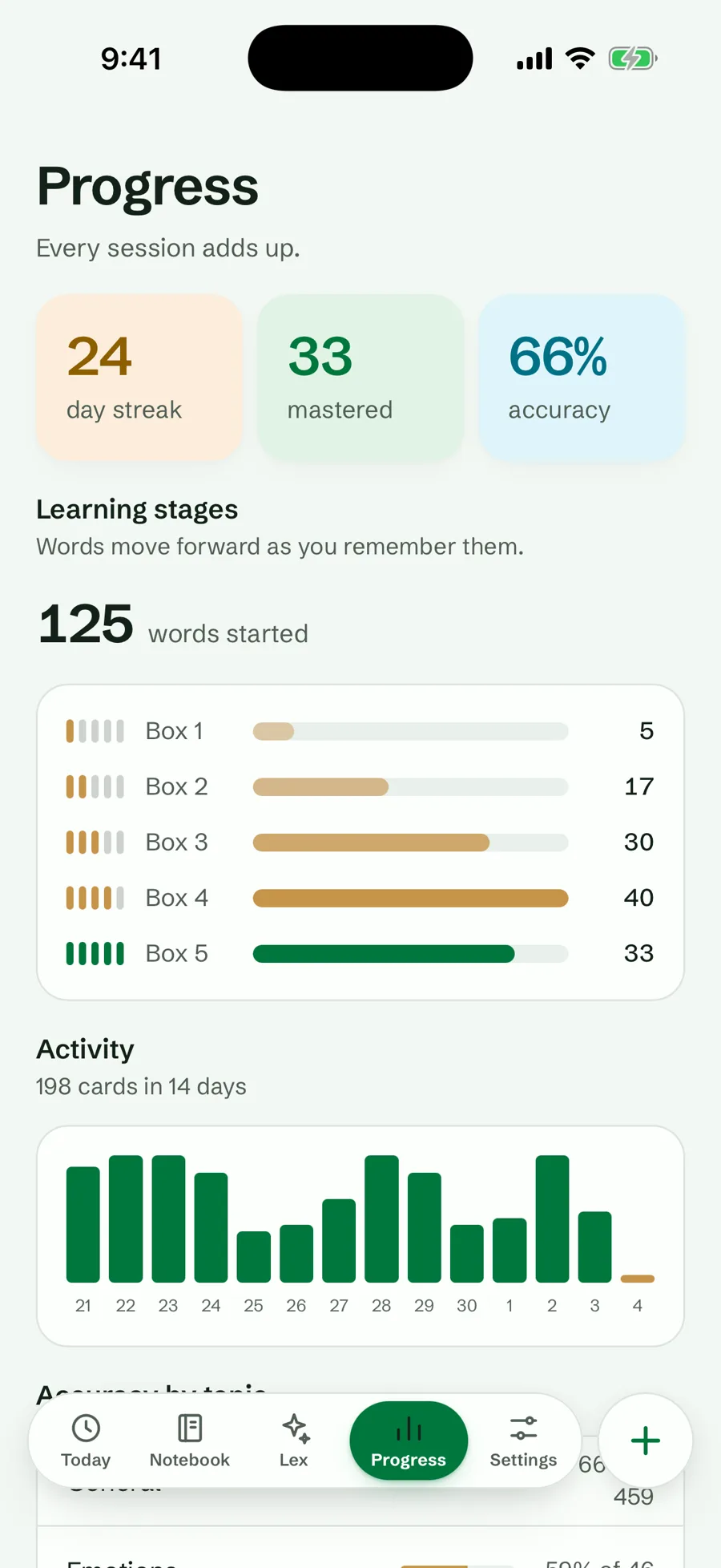
That is all spaced repetition is. The rest is bookkeeping: which words are due today, and how long each one should wait. Here is one schedule, the five boxes Lexpad uses by default:
- Box 1Today
- Box 21 day
- Box 33 days
- Box 47 days
- Box 5 · mastered21 days, then longer
A word you know every time is seen on days 0, 1, 4, 11 and 32. In Lexpad a word in box 5 counts as mastered and then waits 45, 90, 180 and 365 days while you still know it; a miss sends it back to box 1.
Why it works
Spacing. In 1885 Hermann Ebbinghaus tested his own memory of lists of syllables and found that, in his words, “38 repetitions, distributed in a certain way over the three preceding days, had just as favorable an effect as 68 repetitions made on the day just previous” (Ebbinghaus, Memory, section 34). A review of 317 experiments later found the spacing effect again and again, and found that the right gap grows with how long you want to remember (Cepeda et al., 2006).
Testing. Recalling a word does more than looking at it again. Students who learned Swahili–English word pairs and kept testing themselves remembered far more a week later than students who kept studying the pairs (Karpicke and Roediger, 2008, Science). A review of ten study techniques rated these two, practice testing and spaced practice, the most useful (Dunlosky et al., 2013).
For vocabulary the two fit naturally: a flashcard is a test, and a schedule spaces the tests. How to memorize vocabulary covers the whole method, including keeping each word with its sentence.
Three kinds of schedule
Every spaced-repetition app has to decide when a word comes back. Most use one of three kinds of rule.
Leitner boxes are the oldest and simplest. Sebastian Leitner described them in his 1972 book So lernt man lernen: cards move up a box when you know them and back to the first box when you miss, and each box has its own wait. The Leitner system explained.
SM-2 is the rule Piotr Woźniak wrote for the first SuperMemo program in 1987: the first gap is 1 day, the second 6 days, and each later gap is the previous one times the card’s easiness factor, which starts at 2.5 and falls when a card is hard. A grade below 3 starts the card’s repetitions again (SuperMemo, algorithm SM-2). Anki’s older scheduler is SM-2.
FSRS (Free Spaced Repetition Scheduler) is open source. It keeps a small model of your memory of each card and schedules the review for the day your chance of recalling it falls to a target you choose. It grew out of research on memory data from the language app MaiMemo (Ye, Su and Cao, KDD 2022). In the open SRS benchmark, run on review histories from Anki users, it predicts recall better than many other models; that benchmark measures prediction and has no Leitner-box model.
| Leitner boxes | SM-2 | FSRS | |
|---|---|---|---|
| From | Sebastian Leitner, 1972, for paper cards | Piotr Woźniak’s SuperMemo, 1987 | Jarrett Ye and colleagues; research paper 2022 |
| What sets the next gap | The box the card is in. Every card in a box waits the same. | The last gap times an “easiness factor” of the card, which starts at 2.5 and changes with your grades | A memory model of the card: how hard it is for you, how stable your memory of it is, and your chance of recalling it |
| First gaps | Set by the boxes. In Lexpad: today, 1, 3, 7 and 21 days | 1 day, then 6 days, then growing | Worked out for each card from your answers |
| After a miss | Back to the first box | Repetitions start again from the beginning | The card comes back soon, and its memory record is marked down |
| What you choose | Nothing, apart from the waits | Nothing; you grade each answer from 0 to 5 | A target: the chance of remembering you want, such as 90% |
| On paper | Yes | With a calculator | No: it needs a computer |
Which apps use which schedule
“Which apps use FSRS?” is a common question, and the answer changes as apps add schedules. This table lists only what each app’s own documentation or listing said on the day we read it. Other apps may use these schedules too.
| App | Schedule | How it is set | Source |
|---|---|---|---|
| Anki | FSRS or SM-2 | SM-2 (the manual calls it legacy) unless you turn FSRS on in the deck options, for the whole collection. FSRS works in Anki and AnkiMobile 23.10 and later, AnkiDroid 2.17 and later, and AnkiWeb. | Anki manual, deck options |
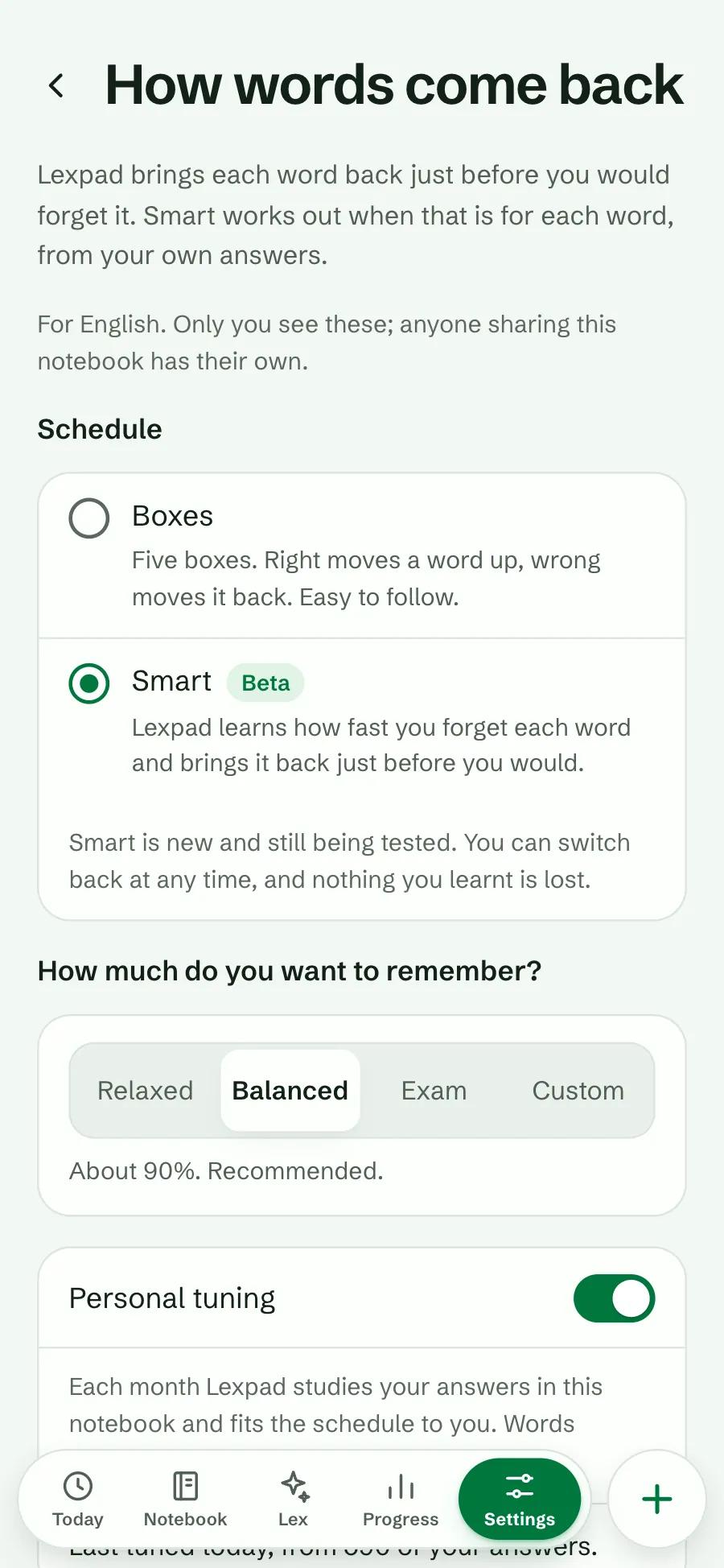
| Lexpad (ours) | Leitner boxes, or FSRS-6 as the Smart schedule (Beta) | Boxes by default. Smart is chosen per notebook, with a target; both are free. | Smart schedule, practice |
| Mochi | Its own algorithm, or FSRS | Its own algorithm by default; FSRS in Settings, Review Settings | Mochi docs, FSRS |
| Quizlet | Spaced repetition; method not named | Its listing says it “resurfaces exactly what you need to review” | US App Store |
| RemNote | SM-2 or FSRS v6 | SM-2 by default; FSRS v6 chosen as the scheduler type, for all cards or per document or folder | RemNote help, FSRS |
| Wokabulary | Learning levels; method not named | New and difficult words come back more often, old and easy ones less | wokabulary.com |
Lexpad’s Smart schedule is FSRS-6 with its standard parameters, in whole days: Knew it counts as FSRS’s Good and Didn’t know as Again. Targets are Relaxed (about 85%), Balanced (about 90%, recommended), Exam (about 95%) or Custom from 80% to 97%. We have not measured on Lexpad whether Smart means fewer reviews than boxes, so we promise no number.
Which schedule to choose
- Boxes if you want to see the rule and predict every date, if your notebook is new or small, or if you work on paper.
- FSRS for a large notebook kept for months, words of very different difficulty, or a test where you want to raise the target for a few weeks.
- Either is a sound choice. The habit matters more than the algorithm: a few minutes every day.
The head-to-head, with Lexpad’s real numbers and how to switch without losing progress: Leitner boxes or FSRS.
How to start
On paper. Write each word on a card with its sentence on the front and its meaning on the back. Keep five piles. New cards go in the first; test pile 1 every day and the higher piles less and less often. A card you know moves up a pile; a card you miss goes back to the first. It costs nothing; the hard part is remembering which piles are due.
In an app. In Lexpad, our own app, it takes three steps:
- Add a word with Add a word, or save it where you meet it: a web page, any app on a computer, a Kindle, a pasted text or a chat with ChatGPT or Claude. Fill with AI writes the card; you can change anything.
- Open Today each day and practise what is due. New words start with recognition; recall and spelling join once a word reaches box 2.
- Leave the five boxes on, or try Smart for one notebook: Settings, Notebooks, How words come back. Switching keeps every box and date.
How many new words a day. Each new word brings reviews with it. On Lexpad’s boxes, N new words a day means about 3N reviews a day after a week and 5N after a month, before any misses. Lexpad brings in 15 new words a day by default. How many new words a day works out the load.
Making it work
- Answer honestly. Marking a word right when you were not sure only brings it back later, when it is harder.
- Test both ways. Word to meaning, then meaning to word. Recalling the word is harder, and it is what you need to use it.
- Keep sessions short and daily. A few minutes a day beats an hour once a week.
- Do not panic after a break. Nothing is lost; due words wait. In Lexpad, a daily limit on reviews (50, 100 or 200) spreads a backlog over several days.
- Use your own words. Words you met, with the sentence you met them in, are easier to keep than a list.
Sources
- Ebbinghaus, H. (1885). Memory: A Contribution to Experimental Psychology, translated 1913, chapter 8, section 34. Classics in the History of Psychology.
- Cepeda, N. J., et al. (2006). Distributed practice in verbal recall tasks. Psychological Bulletin 132(3). doi.
- Karpicke, J. D., and Roediger, H. L. (2008). The critical importance of retrieval for learning. Science 319. doi.
- Dunlosky, J., et al. (2013). Improving students’ learning with effective learning techniques. Psychological Science in the Public Interest 14(1). doi.
- Leitner, S. (1972). So lernt man lernen. Freiburg: Herder.
- Woźniak, P. (1990). Algorithm SM-2, from the first SuperMemo program (1987). SuperMemo archive.
- Ye, J., Su, J., and Cao, Y. (2022). A stochastic shortest path algorithm for optimizing spaced repetition scheduling. KDD 2022. doi; open SRS benchmark.
- App documentation, read 14 October 2026: Anki manual, Mochi docs, RemNote help, Quizlet on the US App Store, wokabulary.com.
Good to know
Questions
What is spaced repetition in simple words?
Testing yourself on something again and again, with longer gaps each time you remember it and a short gap when you forget. The words you know come back rarely, the words you do not know come back often.
Does spaced repetition work for vocabulary?
Yes. Spaced practice and testing yourself are two of the most strongly supported study methods in learning research, and much of that research used words: verbal recall tasks and word pairs. It does not choose your words or teach you how to use them; reading, listening and speaking do that.
Is the Leitner system spaced repetition?
Yes, its simplest kind: fixed boxes with fixed waits. SM-2 and FSRS work out a gap for each card instead.
Which apps use FSRS?
From their own documentation, read on 14 October 2026: Anki (from version 23.10, turned on in the deck options), Lexpad (the Smart schedule, FSRS-6, Beta), Mochi (optional) and RemNote (FSRS v6, optional). Other apps may use it too.
How long does it take to learn a word with spaced repetition?
On Lexpad’s boxes, a word you know every time reaches box 5, mastered, in under two weeks, after being seen on days 0, 1, 4 and 11. Keeping it for years takes a few more reviews, months apart.
What if I miss a day?
Nothing is lost. The due words wait for you, and the schedule carries on from your next answer. After a long break, review the most urgent words first and add fewer new ones for a while.
Is there a free spaced repetition app for vocabulary?
Yes. Anki on a computer and AnkiDroid are free. Lexpad’s free plan has unlimited words, both schedules and every card type. Mochi and RemNote have free plans too; check which scheduler settings each plan includes.
Lexpad
Your next word is worth keeping.
Lexpad is free to start, on the web and on Android. Bring the words you meet.