 Lexpad
IELTS vocabularyIELTS vocabulary:
build your own list
IELTS does not test a word list. In Writing and Speaking, examiners score your Lexical resource: how wide, precise and natural your vocabulary is, including less common words, collocations and paraphrase, as one of four equally weighted criteria. The way to build it is your own list: collect words and collocations from IELTS-style reading and listening, keep each with the sentence you met it in, test yourself at growing gaps, and use every entry in your own writing and speaking.
By Reza Pirighadim, who makes Lexpad. Checked against the app on 20 October 2026.
- Scored as
- Lexical resource, 1 of 4 criteria
- Collect
- Collocations and phrases, with the sentence
- Review
- Days 1, 4, 11, 32
- Use
- In your own writing and speaking
What examiners look for
IELTS Writing is marked on four equally weighted criteria: Task Achievement (Task Response in Task 2), Coherence and Cohesion, Lexical Resource, and Grammatical Range and Accuracy (IDP, IELTS Writing scores). Speaking is marked on Fluency and Coherence, Lexical Resource, Grammatical Range and Accuracy, and Pronunciation (IDP, IELTS Speaking scores). Reading and Listening test your vocabulary too, through the texts you have to understand.
Read the Lexical resource lines closely: they ask for range, precision, collocation, style and paraphrase. None of them asks for a particular list of words.
| Band | Writing | Speaking |
|---|---|---|
| 8 | A wide resource is fluently and flexibly used to convey precise meanings. Skilful use of uncommon and/or idiomatic items, despite occasional inaccuracies in word choice and collocation. | Uses a wide vocabulary resource readily and flexibly to convey precise meaning. Uses less common and idiomatic vocabulary skilfully. Uses paraphrase effectively. |
| 7 | The resource is sufficient to allow some flexibility and precision. Some ability to use less common and/or idiomatic items. An awareness of style and collocation is evident. | Uses vocabulary resource flexibly to discuss a variety of topics. Some less common and idiomatic vocabulary, some awareness of style and collocation. Uses paraphrase effectively. |
| 6 | Generally adequate and appropriate for the task; meaning generally clear in spite of a rather restricted range or a lack of precision in word choice. | Has a wide enough vocabulary to discuss topics at length and make meaning clear. Generally paraphrases successfully. |
Why your own list beats a downloaded one
- Precision comes from context. A word from a list arrives without the sentence that shows how it is used. A word you met in a passage comes with its collocation, register and meaning.
- You already know half of any list. Your own list holds only the words you did not know, so every minute of review counts.
- Collocations and phrases, not single words. The descriptors reward “awareness of style and collocation”. Collect “pose a threat”, not “threat”.
- Writing words down is not enough. Norbert and Diane Schmitt recommend recording more than a translation and reviewing at expanding intervals (Schmitt and Schmitt, 1995); testing yourself beats rereading (Karpicke and Roediger, 2008).
How to build it, step by step
- Choose your sources. Official practice tests (reading passages and listening scripts) and quality news on everyday IELTS themes such as education, work, environment, health and technology.
- Collect three to five entries a session. Prefer phrases and collocations you would like to use, and words you had to guess.
- Write a full entry. The phrase in its usual form, a short meaning (in your own language is fine), the sentence it came from, and a topic tag.
- Test yourself, do not reread. Cover the meaning and recall it, the day after, then on days 4, 11 and 32. A miss starts the word again.
- Use it the same week. Write one sentence of your own in a Task 2 style, and say it aloud in a Part 3-style answer. A word you have used is a word you can find under pressure.
- Group paraphrases you have met. When two entries say the same thing (“a large part of”, “a significant proportion of”), link them: paraphrase is in the descriptors.
| Entry | Meaning | The sentence it came from | Topic, and a note |
|---|---|---|---|
| pose a threat (to) | be a danger to | Rising sea levels pose a threat to coastal cities. | Environment. Collocation: “pose”, not “make”. |
| a significant proportion of | a large part of | A significant proportion of students now study online. | Education. Good for Task 1 data. |
| be reluctant to | not want to do something | Many people are reluctant to give up their cars. | Transport. Paraphrase of “do not want to”. |
| outweigh | be greater or more important than | The benefits of remote work outweigh the drawbacks. | Work. Task 2 opinion essays. |
Your IELTS list in Lexpad
Lexpad, our own app, is a notebook for exactly this. Use an English notebook, with meanings in your language (or English in English for simple definitions), and give each entry its topic. Type a phrase with Add a word and Fill with AI writes the meanings, examples and pronunciation; you can change anything. Reading online, the browser extension saves a selected phrase with its sentence.
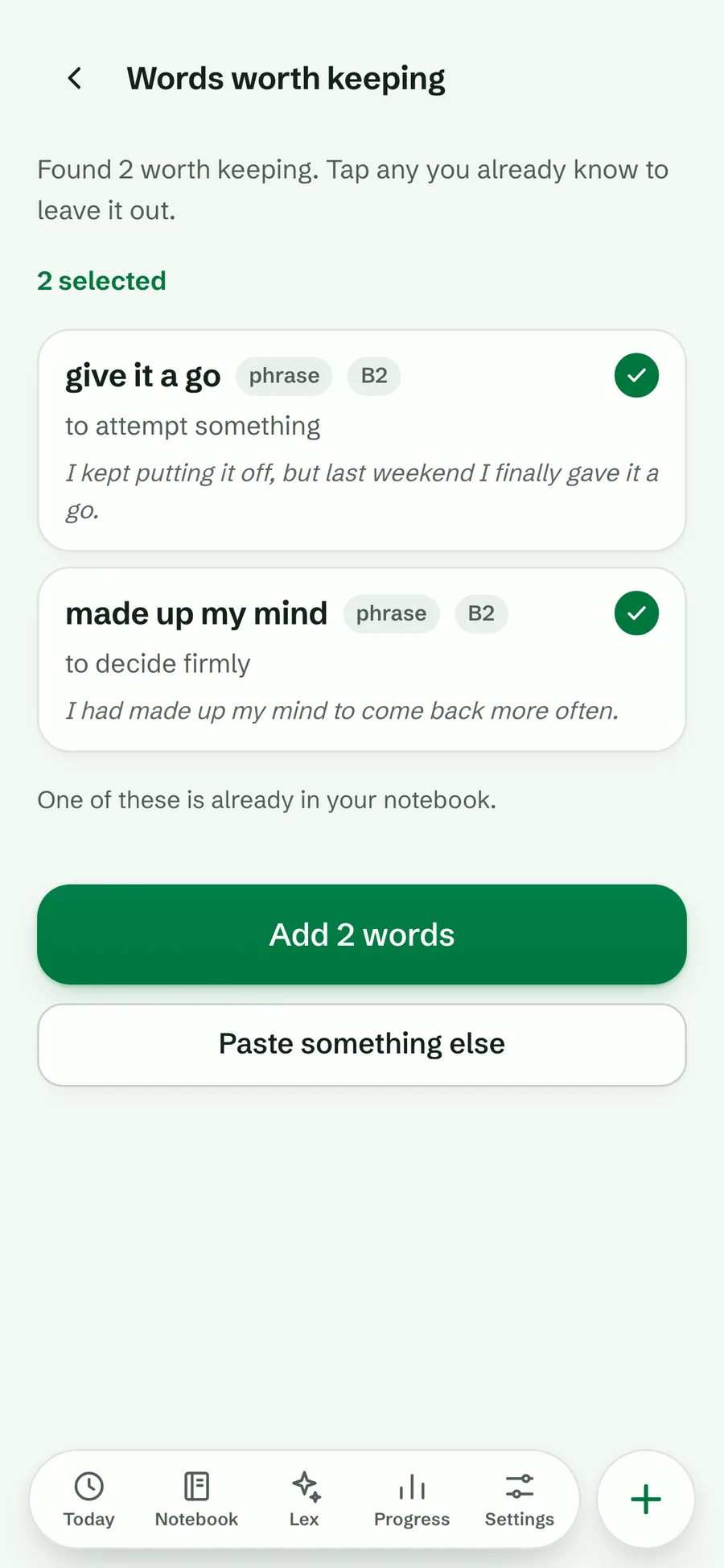
- Words worth keeping (Pro): paste a passage and the AI marks its fixed expressions, collocations and phrasal verbs first, each in its usual form with its sentence. Strike out what you already know.
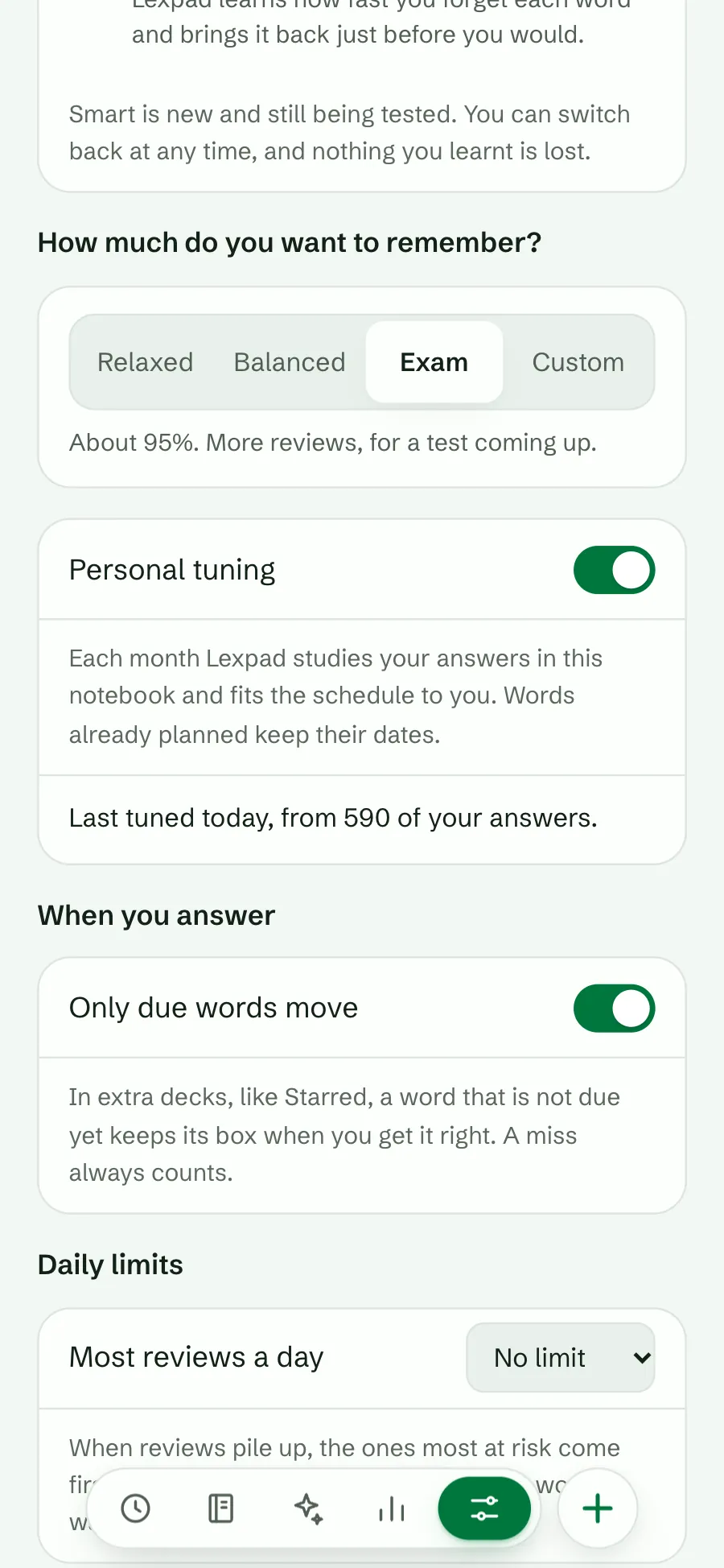
- Five Leitner boxes bring each entry back on days 1, 4, 11 and 32 by default. Before the test you can switch the notebook to the Smart schedule with the Exam target (about 95%: more reviews, for a test coming up), then switch back; every box and date is kept.
- Practice that matches the test. Recall (meaning to word) and spelling join once a word reaches box 2: IELTS marks spelling in Writing.
Prefer paper? Print the free vocabulary notebook template; it has the same columns and review boxes.
Sources
- IDP IELTS, Writing scores and band descriptors, and Speaking scores and band descriptors, read 20 October 2026: Writing, Speaking.
- Schmitt, N., and Schmitt, D. (1995). Vocabulary notebooks: theoretical underpinnings and practical suggestions. ELT Journal 49(2). doi.
- Karpicke, J. D., and Roediger, H. L. (2008). The critical importance of retrieval for learning. Science 319. doi.
Good to know
Questions
How many words do I need for IELTS band 7?
The band descriptors do not give a number. Band 7 asks for some flexibility and precision, some less common and idiomatic items, and awareness of style and collocation. How well you use the words you know matters more than a count.
Is there an official IELTS vocabulary list?
The public band descriptors describe how you use vocabulary; they do not refer to a word list. Lists sold or shared as “IELTS vocabulary” are made by teachers and publishers.
Should I memorise IELTS vocabulary lists?
Lists can show you which topics come up, but words learned without a sentence are hard to use precisely. Take the entries you meet in real passages, with their collocations, and practise using them.
What is Lexical resource in IELTS?
One of the four criteria in Writing and in Speaking: the range of your vocabulary, how precisely and naturally you use it (including collocation and style), your spelling and word formation in Writing, and your paraphrasing.
What is a good app for IELTS vocabulary?
Any spaced-repetition app that keeps your own entries: Anki, Quizlet or Lexpad (ours). Lexpad writes each card with AI, keeps the sentence you met it in, and has an Exam target for the weeks before a test.
How long before the test should I start?
As early as you can: a few new entries a day, reviewed on a schedule, add up to hundreds over a couple of months, and the reviews take minutes a day.
Lexpad
Your next word is worth keeping.
Lexpad is free to start, on the web and on Android. Bring the words you meet.