 Lexpad
Duolingo for vocabularyIs Duolingo good
for vocabulary?
Duolingo is good for a beginner’s core vocabulary: its course picks common words, puts them in sentences and brings them back in review lessons. It is not built for the words you meet in your own life, such as a word from a book, a series or a meeting: we found no way to add your own words to it. Many learners keep Duolingo for the course and add a vocabulary notebook with spaced repetition for everything else; Lexpad, our own app, is one.
By Reza Pirighadim, who makes Lexpad. Checked against the app on 20 October 2026.
- Good for
- A beginner’s core words
- Leaves out
- Words you meet yourself
- Add
- A notebook with spaced repetition
- Checked
- 20 October 2026
What Duolingo does for vocabulary
- It chooses the words. Each course introduces words in a planned order, inside sentences and exercises.
- It brings them back. Duolingo’s own guide to practice says review lessons show “the same vocabulary and grammar” again to strengthen your memory (Duolingo blog, 16 December 2025).
- More practice with Super. The same guide lists a Practice Hub for Super subscribers, with mistakes practice and vocabulary matching. Super Duolingo is sold in the app; the US App Store lists several prices, from $9.99 to $119.99 (US App Store).
- Research behind its reviews. Duolingo has published research on predicting when a learner will forget a word, to schedule practice (Settles and Meeder, ACL 2016).
What it leaves out
A course can only teach the words in the course. The words that matter most to you come from your own life: the novel you are reading, the series you watch, the e-mails at work. Duolingo’s guides and help pages we read describe no way to add a word you met elsewhere (checked 20 October 2026). That is not a flaw of the course; it is a different job.
Two more gaps learners mention: you cannot see when a given word comes back, and a word is tied to the course’s sentences rather than the one you met it in.
| Duolingo | A vocabulary notebook app (such as Lexpad) | |
|---|---|---|
| Who picks the words | The course | You |
| Learning from zero | Yes, with grammar, listening and speaking | No: there is no course |
| A word from your book or series | No way to add it, as far as its pages say | Type it or save it where you meet it |
| The sentence you met it in | No | Kept with the word |
| When a word comes back | Review lessons; dates not shown | Shown on each word (Leitner boxes or FSRS) |
| Price | Free; Super Duolingo sold in the app | Lexpad: free plan with unlimited words; Pro optional |
How to use Duolingo and a notebook together
- Keep your Duolingo habit for structure: new grammar, listening and the course’s words.
- Write down the words you meet outside it the same day, each with the sentence you met it in: a paper vocabulary notebook or an app.
- Add the course words you keep missing. If one word trips you up lesson after lesson, give it its own card.
- Review the notebook for five to ten minutes a day. Test yourself before you look, and let the gaps grow: a day, a few days, a week, three weeks.
Five new words a day of your own is plenty next to a course. How many new words a day works out the review load.
The notebook in Lexpad
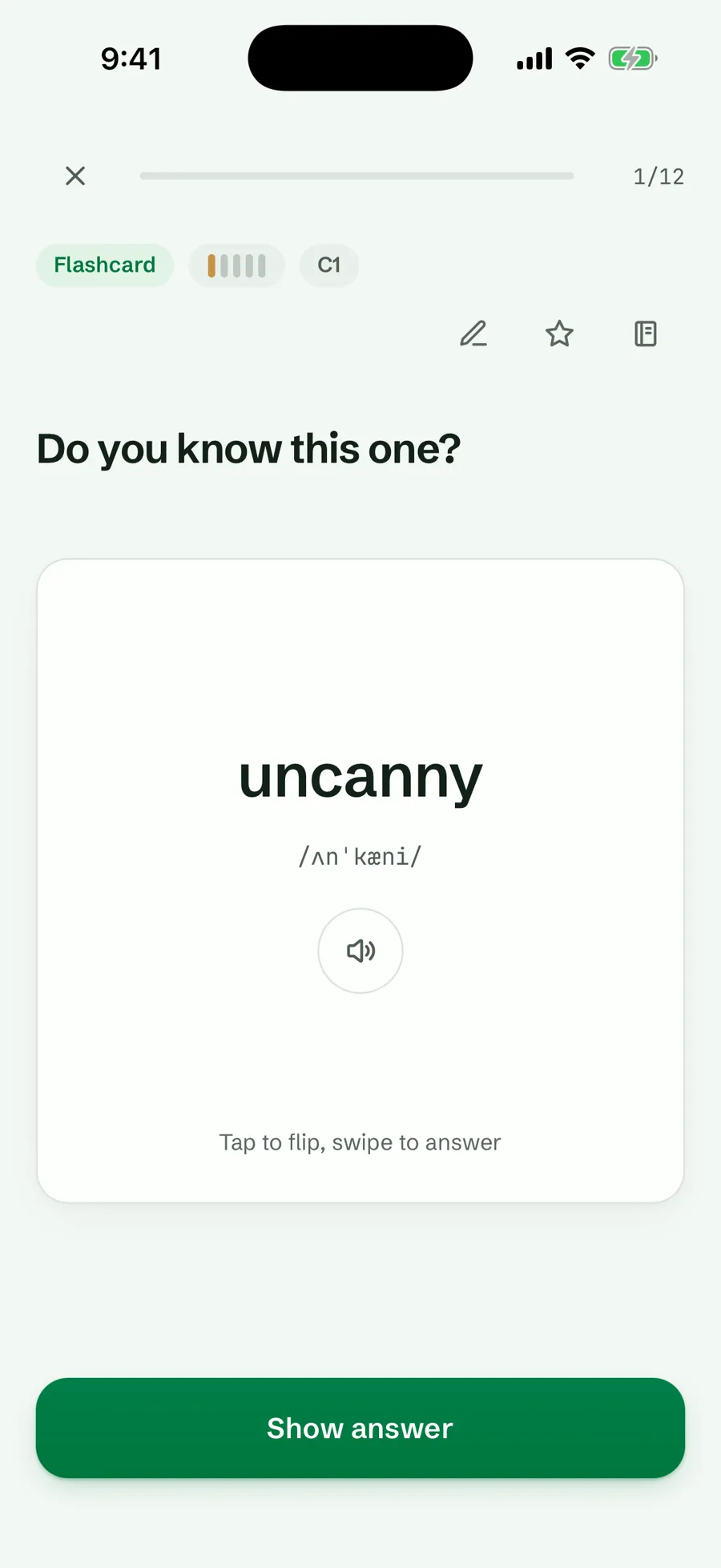
Lexpad, which we make, is a notebook for exactly those words. Type a word with Add a word and Fill with AI writes the meanings in your language, examples with translations and the pronunciation; or save it where you meet it with the browser extension or, on a computer, a shortcut in any app. Five Leitner boxes bring each word back, and Today shows what is due.
It does vocabulary only: no lessons, no grammar course and no word lists, so it sits beside Duolingo rather than replacing it. Free on the web, Android, Mac and Windows; on an iPhone, in the browser.
Sources, checked 20 October 2026
Each fact about another product was read on 20 October 2026 on that product’s own site, help page, blog or US App Store listing. Prices and features change; check the source before you buy.
Good to know
Questions
Is Duolingo good for vocabulary?
For a beginner’s core vocabulary, yes: the course chooses common words, puts them in sentences and brings them back in review lessons. For the words you meet in your own reading, watching and work, you need somewhere to keep them, such as a vocabulary notebook.
Can I add my own words to Duolingo?
Not as far as Duolingo’s own guides and help pages say (checked 20 October 2026). Its courses decide which words you learn. Keep your own words in a notebook or a flashcard app.
Is there a Duolingo for vocabulary?
If you mean an app that drills your own words every day, yes: spaced-repetition apps such as Anki, Quizlet and Lexpad (ours). Lexpad writes each card with AI and keeps the sentence you met the word in.
Does Duolingo use spaced repetition?
Duolingo brings words back in review lessons and has published research on scheduling practice by predicting forgetting (Settles and Meeder, 2016). It does not show you when a given word comes back.
Is Duolingo enough to read books in another language?
Usually not on its own. Reading needs many words outside any course; the usual way is to read, look up and keep the words you meet, and review them on a schedule.
Lexpad
Your next word is worth keeping.
Lexpad is free to start, on the web and on Android. Bring the words you meet.