 Lexpad
Method · Sentence mining
Sentence mining,
step by step
Sentence mining is a name learners use for a simple habit: when you meet a word you don’t know in something you read, watch or hear, you keep it with the sentence it came in, and you turn that into a card you review. Here is how to pick good sentences, what to put on the card, and how much to do.
By Reza Pirighadim, who makes Lexpad. Checked against the app on 25 October 2026.
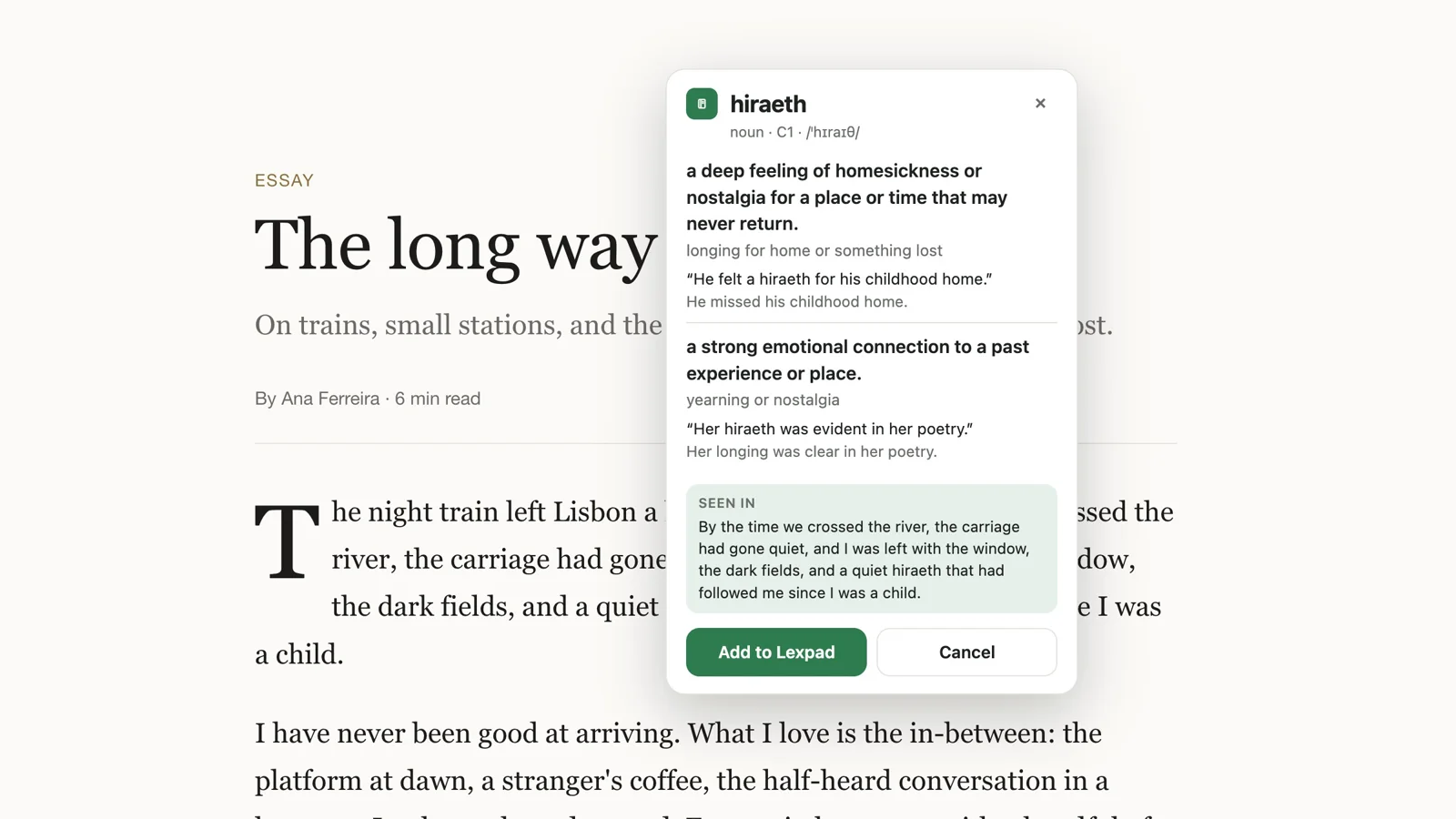
What sentence mining is
The name comes from learner communities, not from a textbook (glossary). The idea is older: learn words from input you mostly understand, and keep them in context. Many learners look for sentences with exactly one new thing in them, sometimes called an i+1 sentence after Krashen’s shorthand.
Why a sentence and not a word list: the sentence shows the word’s meaning in that place, the words it goes with and the grammar around it, and it is a memory of where you met it. The review itself does the rest: answering from memory (Karpicke and Roediger, 2008) at growing gaps (Cepeda and colleagues, 2006).
How to pick a sentence
Most mining goes wrong at this step: sentences with too much new in them make cards you keep failing.
| Keep it when | Leave it when | Example |
|---|---|---|
| One word or phrase is new and the rest is clear. | Three or more words are new. | “She finally got the hang of the new software.” (one new phrase) |
| It makes sense on its own. | It needs the scene or the page before it. | “Yes, that one.” says nothing alone. |
| You can read it in one breath. | It runs over several lines. | Cut a long sentence to the clause that holds the word. |
| You would like to say or write something like it. | It is a name, a number or a one-off joke. | A phrase colleagues use every week beats a rare word. |
What to put on the card
- The word in the form you will look for, such as the dictionary form of a verb, or the whole phrase when the words belong together.
- The sentence exactly as you met it. Don’t tidy it up; the real sentence is the memory.
- The meaning for this sentence, in your own language or simple words. A word with several meanings gets the one you met.
- Where it came from: the book, the video and minute, or the article. It brings the scene back.
One thing to watch: a fill-in-the-blank card can only blank the word if that exact form, or a longer form of it, is in the sentence. If you saved “go” from “we went home”, the card cannot find it there. Either save the form in the sentence, or add a second example that holds the dictionary form.
| Card | Front | You answer with | Trains |
|---|---|---|---|
| Recognition | The sentence, with the word marked | Its meaning | Understanding the word when you read or hear it |
| Cloze | The sentence with the word blanked | The word itself | Recalling the word where it fits |
| Production | The meaning in your language | The word, then a sentence of your own | Using it yourself |
Where to mine
- Reading: web articles, e-books and PDFs. Graded readers are good early on because most sentences have one new thing.
- Videos and series with subtitles in the language you learn: the line on screen is your sentence. Learn vocabulary from videos has a routine.
- Podcasts with transcripts, and your own messages and e-mails in the language.
- Meetings and calls with live captions on: you can read the line you only half heard. Learn English at work covers this.
How many sentences a day
Fewer than it feels like you should. Every card brings reviews for weeks, and a sentence card takes longer than a word card. Start with about five a day and add more only while your daily reviews stay short; try your own numbers in the spaced repetition calculator before you settle on a pace. If reviews pile up, stop adding for a few days rather than skipping reviews.
Tools for sentence mining
- A notebook or a spreadsheet: three columns (word, sentence, meaning) and a date. It works, but you have to plan the reviews yourself.
- Anki with add-ons: popular with serious miners. Dictionary add-ons send a card with the sentence to Anki, and tools such as asbplayer add a screenshot and audio from video (asbplayer on GitHub). It takes some setting up.
- Our free tools: Text to flashcards turns a text or a subtitle file into an Anki file with each word’s sentence, and the Kindle exporter does the same for the words you looked up on a Kindle.
- Lexpad: it keeps the sentence for you wherever you save the word, below.
Sentence mining in Lexpad
Made by the author of this page
The sentence comes with the word
- With the browser extension, select a word on any page, or click one in video subtitles or Google Meet captions: the sentence or line becomes the word’s first example, with a private note of where you met it.
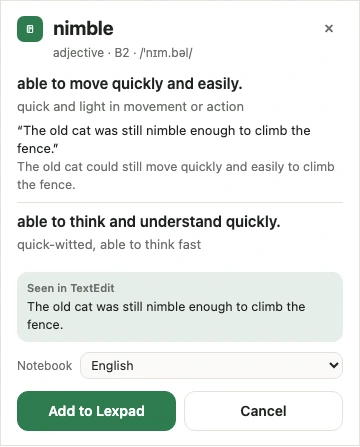
- With Lexpad for Mac and Windows, select a word in any app and press ⌘⇧L or Ctrl+Shift+L; the card shows the sentence when the app shares it, and the note says “Seen in” that app.
- In the web app, Words worth keeping (Pro) reads a text you paste and suggests its useful expressions, each with its sentence.
- In practice, the Example cloze card blanks the word in the first example on its card that contains it, and your own line is the first example. Sentence builder gives one of your own examples back as tiles to put in order, and Dictation can play it aloud.
- AI writes the meanings for the sense in your sentence, and each word comes back on growing gaps on the web, in the Android app and in Lexpad for Mac and Windows.
Free account, no card. Apps: Mac · Windows · Android · iPhone
Free account, no card. macOS 11 or later · All downloads

Free account, no card. Or the direct installer

Free account, no card. Or the APK file
Free account, no card. Lexpad works in Safari on iPhone and iPad.
Free account, no card. Lexpad works in Safari on iPhone and iPad.
 Add to Chrome
Free account, no card. Apps: Mac · Windows · Android · iPhone
 Add to Edge
Free account, no card. Apps: Mac · Windows · Android · iPhone
 Add to Firefox
Free account, no card. Apps: Mac · Windows · Android · iPhone
Good to know
Questions
Is sentence mining good for beginners?
Once you can read simple sentences, yes. Before that, most sentences hold too much that is new. Start with material made for learners, where one new word per sentence is common.
Should a card hold the word or the whole sentence?
Both: the word as the thing you answer, the sentence as its context. A card that asks you to recall a whole sentence is hard to grade and slow to review.
Do I need Anki for sentence mining?
No. Any method that keeps the sentence and brings the word back at growing gaps works: paper with a review plan, Anki, or an app such as Lexpad.
How many sentences should I mine a day?
Start with about five. Watch your daily reviews; if they grow faster than your time, add fewer.
What is an i+1 sentence?
A sentence where you understand everything except one word or phrase. The name comes from Krashen’s “i+1”, input one step beyond your level. See the glossary.
Lexpad
Keep the words you meet.
Save the words you meet with their sentence; AI writes the card and spaced repetition brings each one back. Free to start, on the web, Android, Mac and Windows.
Every new account gets Pro free for 7 days, no card needed.
Free account, no card. Apps: Mac · Windows · Android · iPhone
Free account, no card. macOS 11 or later · All downloads
Free account, no card. Or the direct installer
Free account, no card. Or the APK file
Free account, no card. Lexpad works in Safari on iPhone and iPad.
Free account, no card. Lexpad works in Safari on iPhone and iPad.
Free account, no card. Apps: Mac · Windows · Android · iPhone
Free account, no card. Apps: Mac · Windows · Android · iPhone
Free account, no card. Apps: Mac · Windows · Android · iPhone