 Lexpad
Free tool · Spaced repetitionHow many reviews will
your new words bring?
On Lexpad’s five boxes, every new word a day brings about 5 cards a day from the fifth week and about 8 after a year, if you never miss. Misses add more. Put in your own numbers below: the calculator runs Lexpad’s real schedule, day by day, in your browser.
Made by Reza Pirighadim, who makes Lexpad. Tested on 21 October 2026 against Lexpad’s schedule test file and the tables in our guide.
Work out your numbers
Worked out in your browser on Lexpad’s own scheduling code. Nothing is sent or stored; your choices go in the page’s address, so you can share the result.
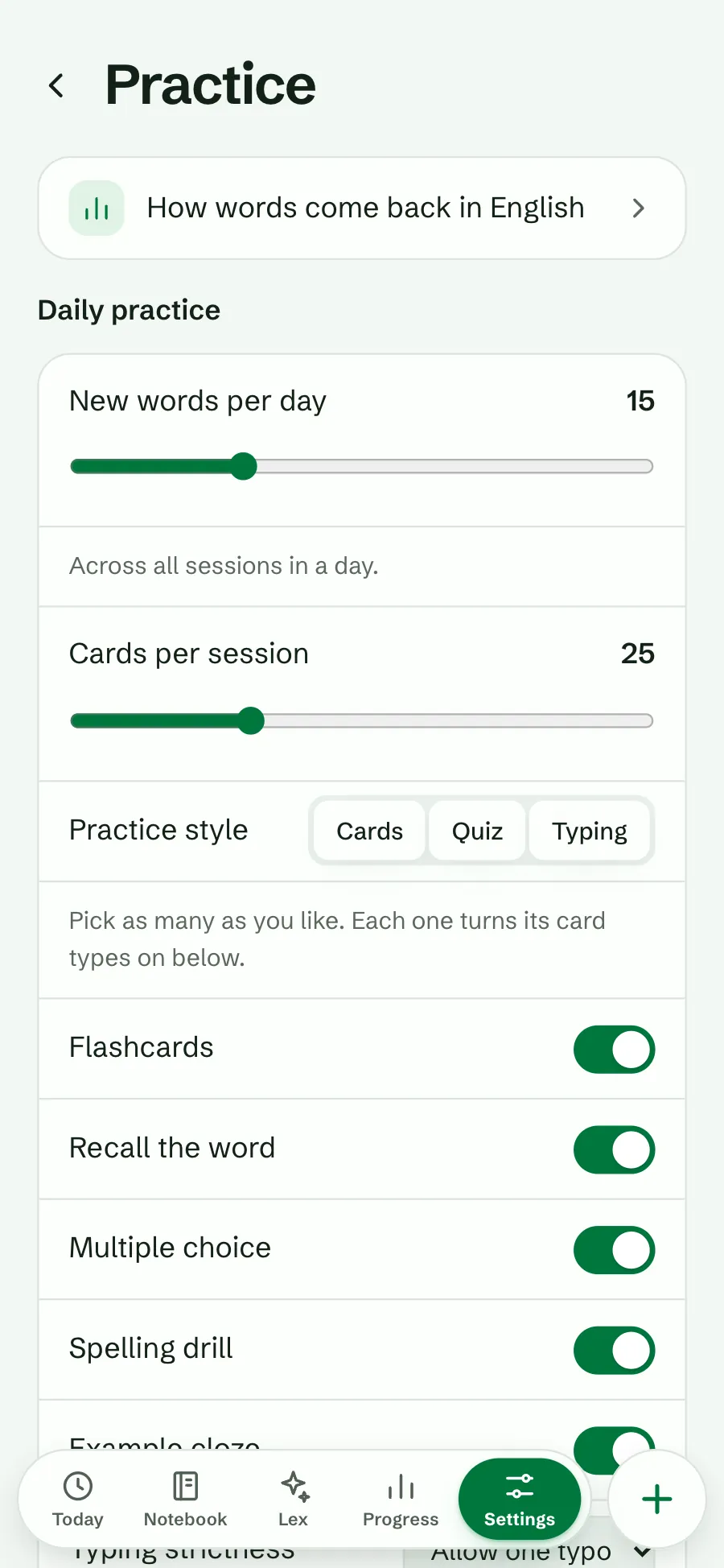
Lexpad’s default is 15.
15 new words a dayboxes, missing 1 in 10
- After a week
- –cards a day
- After a month
- –cards a day, –
- After 3 months
- –cards a day
- After a year
- –cards a day, –
- Busiest week
- –a day
- Words added on
- –
- Mastered by then
- –
| Days | Cards a day | Busiest day | Words added | In box 5 |
|---|
A model of Lexpad’s schedule, not measurements of Lexpad learners. Real misses cluster on a few hard words.
Keep this pace in Lexpad
Set New words per day to 15 in Settings, Practice. Lexpad brings every word back on this schedule, and Progress shows the next 30 days for your own words.
Free account, no card. Apps: Mac · Windows · Android · iPhone
Free account, no card. macOS 11 or later · All downloads

Free account, no card. Or the direct installer

Free account, no card. Or the APK file
Free account, no card. The iPhone app is coming to the App Store. The web app works in Safari today.
Free account, no card. The iPhone app is coming to the App Store. The web app works in Safari today.
 Add to Chrome
Free account, no card. Apps: Mac · Windows · Android · iPhone
 Add to Edge
Free account, no card. Apps: Mac · Windows · Android · iPhone
 Add to Firefox
Free account, no card. Apps: Mac · Windows · Android · iPhone
How the numbers are worked out
The calculator adds your new words each day and answers every card on the day it is due, through the same scheduling code the Lexpad app runs (its srs.ts, fsrs.ts and schedule.ts, copied unchanged from commit cab4d98). Before it went live, that copy was run against Lexpad’s 165 shared test cases for the schedule, the same ones the app and the server must pass.
- Boxes: a new word is asked the day you add it, then after 1, 3, 7 and 21 days. Box 5 counts as mastered; a mastered word you still know waits 45, 90, 180 and then 365 days. A miss sends a word back to box 1, asked again the same day.
- Misses in Boxes: after a word’s first answer, each answer is missed at the rate you choose, at random but from a fixed sequence, so the same inputs always give the same numbers. A word missed is retried once that day and answered right.
- Smart (Beta): FSRS-6 with its published default parameters. Each answer is right with the chance FSRS itself predicts for that day, and each gap is set so that recall falls to your target. Mastered means the same in both: a word in box 5 (in Smart, a memory that lasts 21 days or more).
- Cards a day are 7-day averages; minutes use the app’s own estimate on Today, about 0.4 minutes a card.
Left out of this version: a daily review limit (Most reviews a day) and the pause of new words it brings, Personal tuning of Smart, “Go back two boxes” after a miss, days you skip, and games and extra practice, which never move a schedule.
Boxes or Smart?
Boxes give every word the same fixed steps, so the numbers are easy to predict. Smart works out a gap for each word from your own answers, aiming at the share you want to remember. A higher target means shorter gaps and more reviews a day; the Anki manual says the same about its own FSRS target (Anki manual, deck options). Neither is promised to be lighter: it depends on your answers. Compare them in more depth in Leitner boxes or FSRS?
Choosing your pace
- 5 a day if you have about ten minutes.
- 10 to 15 a day for a steady routine.
- 20 or more only for a short push with time every day.
Why, and what each pace costs over a year: How many new words a day should you learn?
Set it in Lexpad
- New words per day is in Settings, Practice. It counts across all your sessions in a day; words beyond it wait as Not started.
- Most reviews a day, per notebook on its How words come back page, keeps a busy week from piling up: over it, the words most at risk come first and new words pause.
- Progress, Next 30 days, shows the real forecast for your own words. Forecast and retention.
The schedule and these settings are the same on the free plan and on Pro.
Good to know
Questions
How long does it take to learn 1,000 words?
At 15 new words a day, the 1,000th word is added on day 67. Answered right every time, a word reaches box 5 (mastered) with its fourth right answer, 11 days after you add it, so the last of them can be mastered 11 days later at the earliest. Missing 1 answer in 10, about 800 of the 1,000 are in box 5 on day 67, and you see about 100 cards a day in those weeks.
How many reviews do 20 new words a day bring?
On Lexpad’s boxes with no misses: about 90 cards a day after a month and 160 after a year. Missing 1 answer in 10: about 115 after a month and 220 after a year, around 45 and 90 minutes a day. Try your own numbers above.
Is this Anki’s simulator?
No. This is Lexpad’s own schedule. Anki has its own simulator in its deck options when FSRS is on.
Does Smart mean fewer reviews?
We do not claim that. It depends on the target you choose and on your answers; watch your own forecast in Progress.
Is anything I type sent anywhere?
No. The page works everything out in your browser and stores nothing. Your choices are only in the address, so the link you copy can show the same result.
Lexpad
Keep the words you meet.
Lexpad brings each word back on this schedule until it stays. Free to start, on the web, Android, Mac and Windows.
Every new account gets Pro free for 14 days, no card needed.
Free account, no card. Apps: Mac · Windows · Android · iPhone
Free account, no card. macOS 11 or later · All downloads
Free account, no card. Or the direct installer
Free account, no card. Or the APK file
Free account, no card. The iPhone app is coming to the App Store. The web app works in Safari today.
Free account, no card. The iPhone app is coming to the App Store. The web app works in Safari today.
Free account, no card. Apps: Mac · Windows · Android · iPhone
Free account, no card. Apps: Mac · Windows · Android · iPhone
Free account, no card. Apps: Mac · Windows · Android · iPhone