 Lexpad
Method · Phrasal verbs
How to learn phrasal verbs
(without memorising lists)
Give up, look after, put off, work out. English uses phrasal verbs everywhere, and most learners try to memorise them from long lists. Lists are a weak way in, because a phrasal verb’s meaning lives in its sentence. Here is a method that works on the ones you actually meet: collect them where you find them, write them in a form you can learn, and review them at growing gaps.
By Reza Pirighadim, who makes Lexpad. Checked against the app on 25 October 2026.
Why lists of phrasal verbs are hard to learn
A phrasal verb is a verb plus a small word such as up, out, off or on that together make a new meaning (Cambridge Dictionary’s grammar pages explain the types). Three things make a list of them hard to learn:
- One form, many meanings. You can make up a story, make up with a friend, make up for lost time, and five people can make up a team. A list gives one meaning; the sentence you met tells you which one.
- Many meanings is the rule. In a study of the 100-million-word British National Corpus, the 100 most frequent phrasal verbs had 559 possible meaning senses between them, more than five each (Gardner and Davies, TESOL Quarterly 41(2), 2007).
- They look alike. Put off, put out, put on and put up with share a verb. Learned side by side, they blur into each other.
They are worth the effort. The same study estimated that a learner meets one phrasal verb, on average, in every 150 to 192 words of English: about two on every page of written text. Researchers have also built teaching lists, such as the PHaVE List of the 150 most frequent phrasal verbs and their main meanings (Garnier and Schmitt, Language Teaching Research 19(6), 2015). A list like that is useful for checking which meaning is common. The ones you remember, though, are the ones you met in something you cared about.
Collect them where you meet them
Read, watch and listen as usual, and note a phrasal verb when it stops you: a sentence you understood only halfway, or a verb you know with a particle that changed it.
- Reading: mark it and keep the whole sentence. “I kept putting it off” is your example, ready made.
- Videos and series: the subtitle line is the sentence. Learn vocabulary from videos has the routine.
- Meetings and e-mail: colleagues use phrasal verbs constantly (follow up, sort out, push back). Learn English at work shows how to catch them.
- Keep a few. Three to five from a week of reading is plenty. A phrasal verb you meet twice is a better card than one you met once.
Write the form you can learn
What you meet is rarely what you should learn. Turn the line into a card in three steps.
- The base form as the headword. “She gave up smoking” becomes give up. “They’re looking into it” becomes look into. Use sb and sth for the slots: look after sb, put sth off.
- The meaning it had in your sentence. One meaning per card. If you meet another meaning later, add it as a second meaning of the same entry, with its own example.
- Your sentence as the example. Keep the line you met, word for word. It carries the meaning, the grammar and the moment you met it.
Separable or not is part of the form. Some phrasal verbs let the object go in the middle: turn off the light and turn the light off; with a pronoun it must go in the middle: turn it off. Others never split: look after her, never look her after. Write the headword so it shows which: turn sth off against look after sb. A dictionary entry shows the pattern too.
Notice what the particle does
Particles are not random. Many uses of the common ones share a meaning, and noticing it makes new phrasal verbs easier to guess. A few examples:
- up often means completely or to the end: eat up, use up, fill up.
- out often means outward, or to the end: find out, run out, work out.
- off often means away, or stopping: set off, turn off, call off.
Use this to guess and to remember, never as a rule to learn by heart: plenty of phrasal verbs (put up with, make up) have to be learned as wholes.
Review: recall, then use
A phrasal verb you saved once will slip away unless it comes back. Two kinds of practice help most.
- Recall it from its meaning. See “to stop doing something you did regularly” and find give up. That direction is the one you need when you speak and write, and it is harder than recognising the verb. Active recall for vocabulary explains why the effort pays.
- Fill the gap in your own sentence. “I kept ___ it ___” asks for the verb and the particle in the place they actually go.
- Space the reviews. Tomorrow, then a few days, a week, three weeks. A miss brings it back sooner. Spaced repetition for vocabulary covers the schedules.
- Use it within the week. Write one sentence of your own with it, or say it out loud in a meeting or a message. A phrasal verb you have used is the one that comes to mind next time.
Collocations and idioms work the same way
Make a decision, heavy rain, give it a go: collocations and idioms are also chunks whose meaning or naturalness lives in the whole. Keep them the same way: the learnable form as the headword, the meaning in your sentence, your sentence as the example. IELTS vocabulary shows how examiners reward them in Writing and Speaking.
How Lexpad helps
Made by the author of this page
Phrasal verbs from what you read
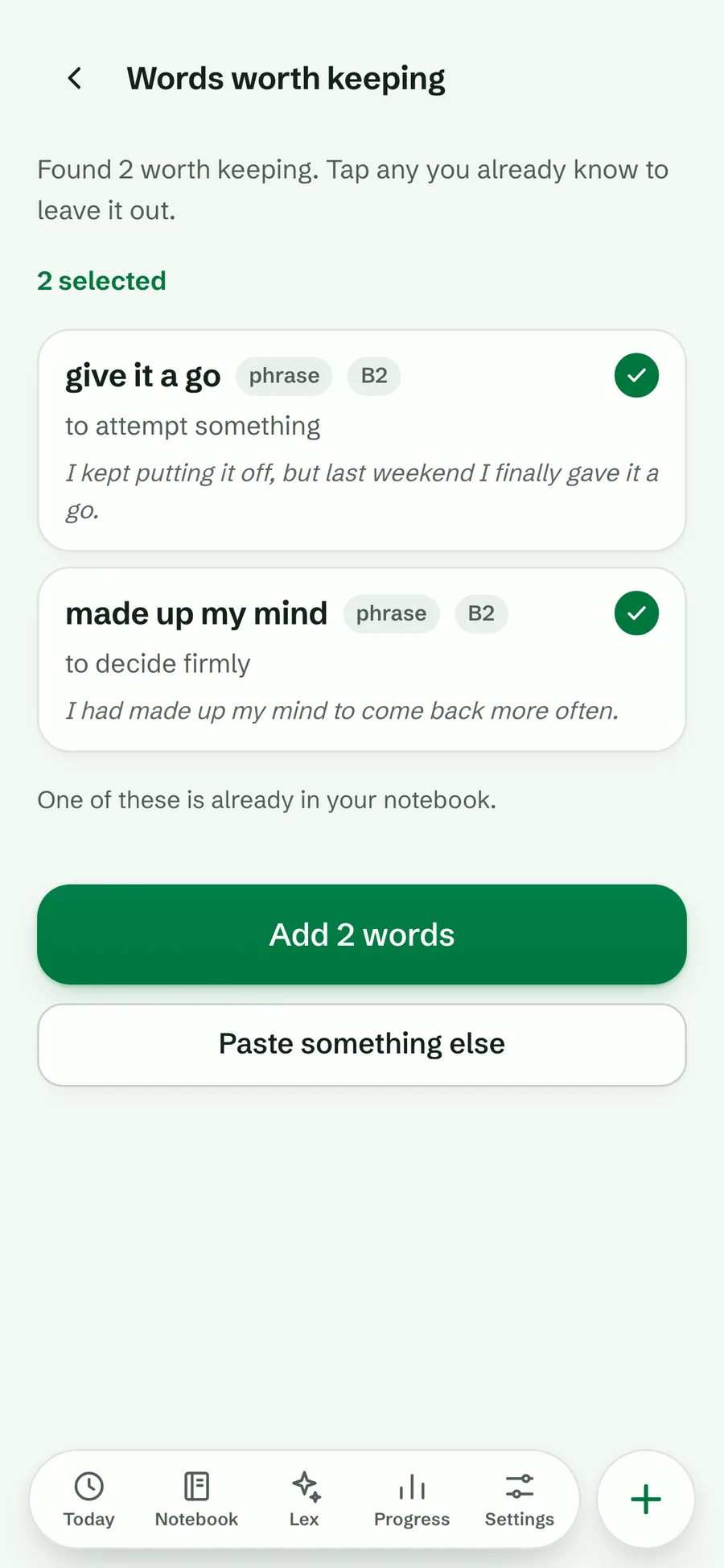
- Words worth keeping (Pro): paste a paragraph you read. The AI marks fixed expressions, idioms, phrasal verbs and collocations first, then ordinary words used in an unusual sense, then rare words. Each comes in its learnable form (“gave up” becomes “give up”) with a short meaning, a CEFR level and its sentence. Everything arrives kept; tap the ones you already know to leave them out.
- In the notebook, the phrasal verbs filter shows only them, and “Practise these” runs a session on that view. Free.
- Cards ask from the meaning as well as from the word, and the Example cloze card puts the verb back into one of its own sentences. Each word comes back after 1, 3, 7 and 21 days while you know it.
- The Collocations game, in Games and drills, practises the collocations saved on your cards. Free.
- Words worth keeping is part of Pro. Every new account gets Pro free for 7 days, no card needed. What Pro includes
Free account, no card. Apps: Mac · Windows · Android · iPhone
Free account, no card. macOS 11 or later · All downloads

Free account, no card. Or the direct installer

Free account, no card. Or the APK file
Free account, no card. Lexpad works in Safari on iPhone and iPad.
Free account, no card. Lexpad works in Safari on iPhone and iPad.
 Add to Chrome
Free account, no card. Apps: Mac · Windows · Android · iPhone
 Add to Edge
Free account, no card. Apps: Mac · Windows · Android · iPhone
 Add to Firefox
Free account, no card. Apps: Mac · Windows · Android · iPhone
Sources, read 25 October 2026
- Gardner, D. and Davies, M. (2007). Pointing out frequent phrasal verbs: a corpus-based analysis. TESOL Quarterly 41(2), 339–359.
- Garnier, M. and Schmitt, N. (2015). The PHaVE List: a pedagogical list of phrasal verbs and their most frequent meaning senses. Language Teaching Research 19(6), 645–666.
- Cambridge Dictionary, English Grammar Today: Phrasal verbs.
Good to know
Questions
What is the best way to learn phrasal verbs?
Collect the ones you meet in reading, videos and conversations, keep each with its sentence and the meaning it had there, write it in its base form, and review it at growing gaps by recalling it from its meaning.
Should I memorise a list of phrasal verbs?
A list helps you check which meanings are common, for example the PHaVE List of 150 frequent phrasal verbs. Phrasal verbs you met in context, with your own sentence, are much easier to remember and to use.
How many phrasal verbs should I learn a day?
Few: three to five a week from your own reading is a good pace alongside other words. Each one brings reviews over the next weeks.
How do I know if a phrasal verb is separable?
A learner’s dictionary shows it: an entry like “turn sth off” can split, “look after sb” cannot. With a pronoun, a separable verb must split: turn it off.
Why do phrasal verbs have so many meanings?
Because the verb and the particle combine differently in different contexts. The 100 most common phrasal verbs have 559 possible meaning senses between them, so learn the meaning your sentence shows.
Lexpad
Keep the words you meet.
Save the words you meet with their sentence; AI writes the card and spaced repetition brings each one back. Free to start, on the web, Android, Mac and Windows.
Every new account gets Pro free for 7 days, no card needed.
Free account, no card. Apps: Mac · Windows · Android · iPhone
Free account, no card. macOS 11 or later · All downloads
Free account, no card. Or the direct installer
Free account, no card. Or the APK file
Free account, no card. Lexpad works in Safari on iPhone and iPad.
Free account, no card. Lexpad works in Safari on iPhone and iPad.
Free account, no card. Apps: Mac · Windows · Android · iPhone
Free account, no card. Apps: Mac · Windows · Android · iPhone
Free account, no card. Apps: Mac · Windows · Android · iPhone