 Lexpad
Essay · How words stick
Word lists or your own words?
Most language apps give you vocabulary lists: the 1,000 most common words, 50 words for the airport, the fruit, the colours. Lexpad starts empty, and this page is the reason. Lists can work, and this page says where. But the words you meet yourself, kept with the sentence you met them in and brought back on time, stick better and are yours to use.
By Reza Pirighadim, who makes Lexpad. Checked against the app on 9 November 2026. How this guide is made.
The short answer
If you are an absolute beginner, a short list of the most common words gets you off the ground. Learn it as pairs, test yourself, and move on within weeks.
After that, stop collecting lists and start collecting words: the ones that stopped you in a book, a video, a meeting or a chat. Keep each with the sentence it was in. Review it tomorrow, in three days, in a week. That is slower per word than a list, and much faster per word you can actually use.
What lists do well
Learners argue about this as if one side must be wrong. The research is less tidy.
Learning words as pairs, a word and its meaning, from cards or a list, is fast, and it builds real knowledge. Irina Elgort had 48 advanced learners of English learn 48 made-up words from word cards, then tested them with the reaction-time methods psychologists use to see whether a word is really in the mental dictionary. The deliberately learned words behaved like real words: they were recognised faster than nonwords and handled more automatically than real but rare English words (Elgort, 2011). Paul Nation has made the same point for years: direct study of word pairs is efficient, and good learners do it.
Lists also win some head-to-head tests. French learners who studied new words with translations recalled more of them than learners who met the same words in sentences, and the weaker learners in particular struggled to use what they had learned in context (Prince, 1996). Japanese learners who studied word pairs, with or without one glossed sentence, scored about the same on ten tests (Webb, 2007). One sentence on its own added little. These studies are set out, with their limits, in sentence mining, step by step.
And frequency lists are good maps. The most common 3,000 word families cover about 95% of the words in films and television (Webb and Rodgers, 2009), so a beginner who learns those first understands more of everything, sooner. That is a strong reason to know the list exists. It is a weaker reason to memorise it as a list, for the reasons below.
Why random lists are slow to stick
A random list here means a list of words you have not met: “500 words for B1”, a themed set, a frequency list from word 1 to word 3,000. Three things go wrong.
The words do not come back on their own. A word you met in a book is in a book you are reading, and it will turn up again in chapter nine. A word from a list is in the list. Between reviews it is nowhere. In one study, words that came up more often in an hour-long documentary were learned more (Peters and Webb, 2018), and reading research has said the same for decades: repeated meetings in real input move a word from “seen once” to “known”. A list has no second meeting built in, so every repetition has to be a review. Spaced repetition makes that efficient (Cepeda and colleagues, 2006), but it is all cost and no free help.
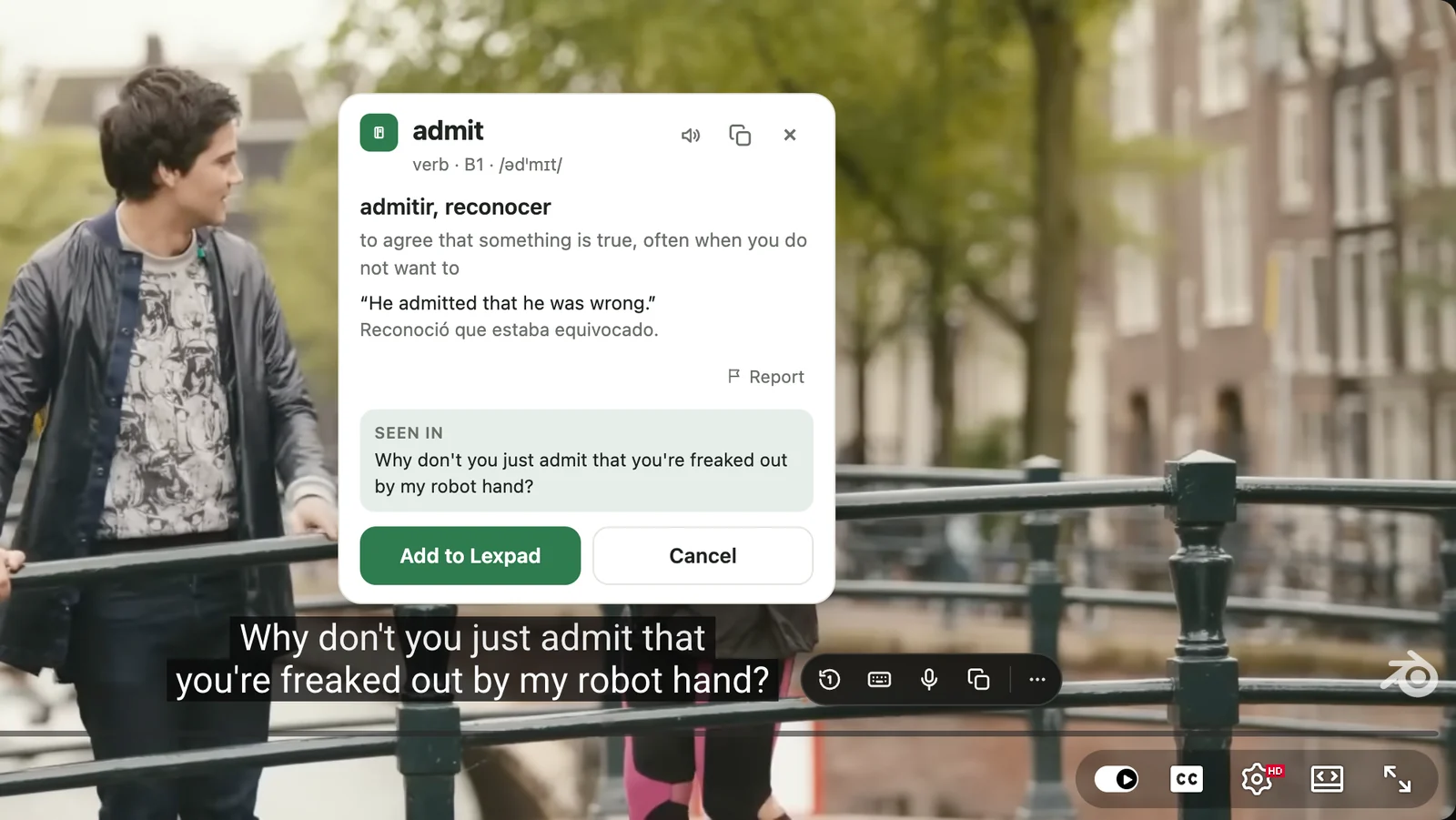
You learn the meaning without the use. A pair gives you one gloss. It does not tell you which preposition follows, whether the word is formal or rude, or what it usually sits next to. “Admit” in a list is “to say something is true”. “Why don’t you just admit that you’re freaked out?” tells you it takes a that-clause, that people say it in arguments, and that it goes with being accused of something. Laufer and Hulstijn put this as involvement: a word sticks in proportion to the need you had for it, the search you did for its meaning, and how you judged whether it fitted (Laufer and Hulstijn, 2001). A list has little of the first and none of the third. Their follow-up found that learners who had to use new words in a composition kept more than learners who filled gaps, who kept more than learners who only read (Hulstijn and Laufer, 2001).
You had no reason to want it. This is the quiet one. The word that stopped you mid-scene comes with a reason: you wanted to know what she said. The 214th word of a frequency list has none. Haggard built a classroom method on this in the 1980s: students chose the words for the week’s list from their own reading, viewing and lives, and said why each one mattered (Haggard, 1986). The words were not better. The students cared which ones they were.
The trap of themed lists
The most natural list of all, ten fruits or the colours or words for the kitchen, has a problem the research found early and keeps finding.
Tinkham taught learners sets of made-up words that were either related in meaning (all clothes, say) or unrelated, and counted how many tries each set took. The related sets took more (Tinkham, 1993). Waring repeated the study with the same result (Waring, 1997). Erten and Tekin taught 60 fourth-graders 80 real English words over a term, in related or unrelated sets: the unrelated sets were learned better, the advantage lasted, and the children were slower to recall the related words (Erten and Tekin, 2008). Nation gathered the evidence in a short article with a plain title, “Learning vocabulary in lexical sets: dangers and guidelines” (Nation, 2000).
The reason is interference. Apricot, peach and plum share almost everything: fruit, round, a stone, summer. Learned together, the three forms attach to one blurry meaning, and you spend the next year saying peach when you mean plum. Not every study finds the effect, and spacing the related words out removes much of it. The simplest fix is also the natural one: meet the words where they live. A recipe has one fruit in it, not ten.
What works better: learning words in context, reviewed on time
Put the three problems side by side and the answer follows.
Your own words come back on their own. They were in a series you are still watching, a book you are still reading, a job you still have. The next meeting is free, and it comes in a new sentence, which is how a meaning gets its edges.
The sentence comes with them. Keep it exactly as you met it. It fixes the meaning you met, shows the words around it, and brings the scene back when you review. A thin sentence adds little and a clue-rich one helps a lot, so pick lines where the word is the only new thing and the rest explains it.
The review is what makes it stay. Bringing a word back from memory is what fixes it. Students who kept being tested on words they had learned recalled about 80% of them a week later; students who stopped being tested once they knew a word recalled about a third (Karpicke and Roediger, 2008). Spread the tests out, with the gaps growing as the word gets easier. On paper that is a Leitner box; in an app it is spaced repetition, and it is the part of the list-learner’s toolkit worth keeping in full.
A week of this looks small: twenty or thirty words, from things you were going to read and watch anyway. A year of it is a vocabulary with your fingerprints on it. You remember where each word came from, you have used most of them, and none of them is “flight attendant” from a travel list you never needed.
“But I have an exam word list”
Keep it. IELTS, TOEFL and school syllabuses hand you lists for a reason: the exam will use those words, and you do not have a year of reading to meet them by chance.
Use the list as a checklist, not as the material. For each word you do not know, find one real sentence that uses it, in the exam’s own practice texts, an article or a video, and keep the word with that sentence instead of the list’s gloss. Learn the list in unrelated chunks of ten rather than by theme, and start reviewing the day you add a word, not the week before the exam. The full routine: IELTS vocabulary, built from your own reading. The same goes for phrasal verbs, where a list of forty is the classic way to learn none of them (how to learn phrasal verbs).
Why Lexpad starts empty
Lexpad is built for the words you meet, so it starts empty. You bring the word; the AI writes the card for it in your two languages, with its meanings, examples and pronunciation, and your sentence goes first. Then spaced repetition brings it back before you forget it. With Pro, Words worth keeping reads a text you paste and marks the expressions, phrasal verbs and unusual words in it, each with its sentence, and you untick what you already know; even then, the words come from something you were reading. Free writes 5 AI cards a day (200 a month); Pro writes them for every word you add, one at a time, up to 1,000 a day. The card is the same on both.
That narrowness is on purpose: Lexpad is for the words you found yourself. How Lexpad works · AI flashcards for the words you keep
Sources, read on 9 November 2026
- Elgort, I. (2011). Deliberate learning and vocabulary acquisition in a second language. Language Learning, 61(2), 367–413. doi.org/10.1111/j.1467-9922.2010.00613.x
- Prince, P. (1996). Second language vocabulary learning: the role of context versus translations as a function of proficiency. The Modern Language Journal, 80(4), 478–493. doi.org/10.1111/j.1540-4781.1996.tb05468.x
- Webb, S. (2007). Learning word pairs and glossed sentences: the effects of a single context on vocabulary knowledge. Language Teaching Research, 11(1), 63–81. doi.org/10.1177/1362168806072463
- Webb, S. and Rodgers, M. P. H. (2009). The lexical coverage of movies. Applied Linguistics, 30(3), 407–427. doi.org/10.1093/applin/amp010
- Peters, E. and Webb, S. (2018). Incidental vocabulary acquisition through viewing L2 television and factors that affect learning. Studies in Second Language Acquisition, 40(3), 551–577. doi.org/10.1017/S0272263117000407
- Laufer, B. and Hulstijn, J. (2001). Incidental vocabulary acquisition in a second language: the construct of task-induced involvement. Applied Linguistics, 22(1), 1–26. doi.org/10.1093/applin/22.1.1
- Hulstijn, J. and Laufer, B. (2001). Some empirical evidence for the involvement load hypothesis in vocabulary acquisition. Language Learning, 51(3), 539–558. doi.org/10.1111/0023-8333.00164
- Haggard, M. R. (1986). The vocabulary self-collection strategy: using student interest and world knowledge to enhance vocabulary growth. Journal of Reading, 29(7), 634–642.
- Tinkham, T. (1993). The effect of semantic clustering on the learning of second language vocabulary. System, 21(3), 371–380. doi.org/10.1016/0346-251X(93)90027-E
- Waring, R. (1997). The negative effects of learning words in semantic sets: a replication. System, 25(2), 261–274. doi.org/10.1016/S0346-251X(97)00013-4
- Erten, İ. H. and Tekin, M. (2008). Effects on vocabulary acquisition of presenting new words in semantic sets versus semantically unrelated sets. System, 36(3), 407–422. doi.org/10.1016/j.system.2008.02.005
- Nation, P. (2000). Learning vocabulary in lexical sets: dangers and guidelines. TESOL Journal, 9(2), 6–10.
- Karpicke, J. D. and Roediger, H. L. (2008). The critical importance of retrieval for learning. Science, 319(5865), 966–968. doi.org/10.1126/science.1152408
- Cepeda, N. J., Pashler, H., Vul, E., Wixted, J. T. and Rohrer, D. (2006). Distributed practice in verbal recall tasks: a review and quantitative synthesis. Psychological Bulletin, 132(3), 354–380. doi.org/10.1037/0033-2909.132.3.354
Good to know
Questions
Should I memorise vocabulary lists?
As a beginner, a short frequency list, yes: learn it as pairs, test yourself, move on. After that, treat lists as maps. Learn the words you meet, with their sentences, and review them at growing gaps.
Is it better to learn words in context or from a list?
For the first link between a word and its meaning, lists are as fast or faster. For knowing how to use the word, and for remembering it a year later, a word met in context, kept with its sentence and reviewed, does better. Most good learners do a little of the first and a lot of the second.
Are themed word lists bad?
Learned together, related words get in each other’s way: several studies found that sets such as fruit or clothes took longer to learn and were recalled more slowly. Meet them in real texts instead, or spread a themed set over weeks.
How many words should I learn a day?
Three to ten new ones, from what you read and watch, with their sentences. Reviews are the real cost: how many new words a day.
Does Lexpad suggest words?
Only from your own text. With Pro, Words worth keeping points out expressions and unusual words in a text you paste, with their sentences, and you remove the ones you know. Every other word in your notebook is one you added.
Lexpad
Keep the words you meet.
Save the words you meet with their sentence; AI writes the card and spaced repetition brings each one back. Free to start, on the web, Android, iPhone, Mac and Windows.
Every new account gets Pro free for 7 days, no card needed.
Free account, no card. Apps: Mac · Windows · Android · iPhone
Free account, no card. macOS 11 or later · All downloads

Free account, no card. Or the direct installer

Free account, no card. Or the APK file

Free account, no card. The app for iPhone and iPad.
Free account, no card. The app for iPhone and iPad.
 Add to Chrome
Free account, no card. Apps: Mac · Windows · Android · iPhone
 Add to Edge
Free account, no card. Apps: Mac · Windows · Android · iPhone
 Add to Firefox
Free account, no card. Apps: Mac · Windows · Android · iPhone